Google Ads for Shopify Stores: A Complete Strategy Guide
- February 23, 2026
Introduction: Why Most Shopify Brands Struggle With Paid Advertising
Shopify has simplified ecommerce infrastructure to an unprecedented degree. Entrepreneurs can launch a functional store within days using the platform’s intuitive setup, integrated payment systems, and theme customization tools. However, building a store and scaling revenue are fundamentally different challenges. Many Shopify founders quickly realize that organic growth alone is insufficient in competitive markets. Paid acquisition becomes necessary, and Google Ads is often the first channel they test.
Despite its potential, many brands fail when launching google ads for shopify. The issue rarely lies in Google’s advertising ecosystem. Instead, it stems from a lack of structural planning. Campaigns are activated without profit modeling, conversion tracking is implemented incorrectly, automation is relied upon prematurely, and budgets are increased emotionally rather than strategically. These mistakes compound quickly and create volatility.
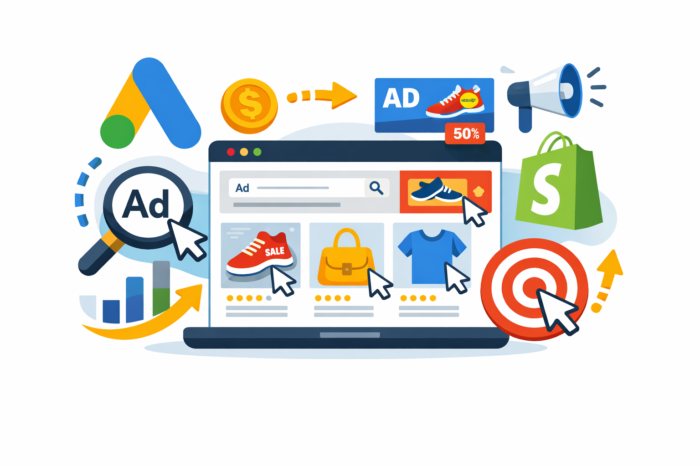
A properly structured approach to google ads for shopify transforms advertising from an experimental expense into a scalable growth engine. This guide explains how to design that system from the ground up.
Common Question Asked:
What’s your approach for migrating a large e-commerce site to Shopify?
A successful migration requires careful planning and data validation to transfer critical data, like customer info and product details, without loss. The developer should validate data to ensure nothing is lost or corrupted. Rigorous testing follows at each stage, providing all features work smoothly.
How to Set Up Google Ads for Your Shopify Store.
Step 1: Create a Google Ads Account
Before anything else, you need a Google Ads account. If you already have one, skip to Step 2.
- Go to ads.google.com and click Get started.
- Sign in with your Google account or create a new one.
- When prompted, select Switch to Expert Mode at the bottom of the screen — this gives you full control over campaign settings.
- Choose Create an account without a campaign for now.
- Fill in your billing country, time zone, and currency, then click Submit.
Pro Tip: Use the same Google account you use for other Google services (like Google Search Console or Google Analytics) to keep everything organized.
Step 2: Connect Google Ads to Your Shopify Store
Connecting Google Ads to Shopify allows you to sync your products, track conversions, and run Shopping ads automatically.
Option A: Use the Google & YouTube Shopify App (Recommended)
- In your Shopify admin, go to Apps > Search for Google & YouTube.
- Install the app and click Get Started.
- Connect your Google account and select your Google Ads account.
- Set up your Google Merchant Center account (required for Shopping ads).
- Sync your product catalog — Shopify will automatically send your products to Google.
Option B: Manual Connection via Google Tag Manager
If you prefer more control, you can manually install the Google Ads tag on your Shopify store:
- In Google Ads, navigate to Tools & Settings > Measurement > Conversions.
- Click the + button to create a new conversion action.
- Select Website and follow the setup wizard.
- Copy the Global Site Tag (gtag.js) code snippet.
- In Shopify, go to Online Store > Themes > Actions > Edit Code.
- Paste the tag inside the <head> section of your theme.liquid file.
Step 3: Set Up Conversion Tracking
Conversion tracking is essential — it tells Google Ads which clicks lead to actual sales, so the algorithm can optimize for buyers instead of just browsers.
- In Google Ads, go to Tools & Settings > Conversions.
- Click + New Conversion Action > Website.
- Enter your Shopify store URL and click Scan.
- Select Purchase as the conversion event and set the value (you can use the actual transaction value from your order confirmation page).
- Install the event snippet on your Shopify order confirmation page (usually /thank_you or order-status.liquid).
- Verify the tag is firing using Google Tag Assistant Chrome extension.
Important: Do not run campaigns without conversion tracking. Without it, Google can’t optimize for sales and you’ll be spending budget inefficiently.
Step 4: Set Up Google Merchant Center
Google Merchant Center (GMC) is required if you want to run Shopping or Performance Max campaigns, which show your actual product images and prices in search results.
- Go to merchants.google.com and sign in with your Google account.
- Enter your business name, country, and time zone.
- Verify and claim your Shopify store URL.
- Link your Merchant Center account to your Google Ads account: In GMC, go to Settings > Linked Accounts > Google Ads.
- Sync your Shopify products via the Google & YouTube app or a product feed.
Step 5: Create Your First Google Ads Campaign
Now it’s time to create your first campaign. There are several campaign types — here’s what works best for Shopify stores:
Best Campaign Types for Shopify
- Performance Max (PMax) — Google’s all-in-one campaign type. Recommended for most Shopify stores as it covers Search, Shopping, Display, YouTube, and Gmail.
- Shopping Campaigns — Ideal for product-focused stores. Shows product images, prices, and store names directly in Google search results.
- Search Campaigns — Text-based ads that appear when users search for keywords related to your products. Great for brand and high-intent keywords.
How to Create a Performance Max Campaign
- In Google Ads, click + New Campaign.
- Select Sales as your campaign objective.
- Choose Performance Max as the campaign type.
- Select your Merchant Center account and choose the products or product groups you want to advertise.
- Name your campaign and set a daily budget (start with $10–$20/day to test).
- Set your bidding strategy — choose Maximize Conversion Value with a target ROAS if you have past conversion data, or Maximize Conversions if you’re starting fresh.
- Choose your location targeting (countries or regions you ship to).
- Add your asset groups: headlines (up to 15), descriptions (up to 4), images, logos, and videos (or let Google auto-generate them).
Step 6: Set Up Audience Signals & Remarketing
Audience signals help Performance Max campaigns find high-value customers faster. Remarketing lets you re-engage visitors who didn’t convert.
- In your PMax campaign, go to the Audience Signals section.
- Add your Customer Match list (upload your existing customer email list).
- Add website visitor audiences (requires the Google Ads tag installed on your site).
- Add in-market audiences relevant to your product niche (e.g., “Home & Garden” if you sell furniture).
- Use Custom Segments to target users who’ve searched for your competitors’ brand names.
Step 7: Write Compelling Ad Copy
Your ads need to stand out and compel users to click. Follow these best practices:
- Headlines: Include your primary keyword in at least one headline. Highlight key benefits (e.g., “Free Shipping,” “30-Day Returns,” “Up to 40% Off”).
- Descriptions: Expand on your value proposition. Use action words like Shop, Discover, Save, or Get.
- Use ad extensions (now called Assets): Add sitelinks, callouts, structured snippets, price extensions, and promotion extensions to maximize ad real estate.
- Always match your ad copy to your landing page — if your ad mentions “Summer Sale 50% Off,” the landing page should reflect that.
Step 8: Optimize Your Product Feed
For Shopping and Performance Max campaigns, the quality of your product feed directly impacts how often and to whom your ads are shown.
- Product Titles: Include primary keywords naturally (e.g., “Men’s Blue Running Shoes – Size 10 – Nike” instead of just “Running Shoes”).
- Product Images: Use high-quality, white-background images. Google may disapprove images with text overlays or watermarks.
- Descriptions: Write detailed, keyword-rich descriptions that accurately describe the product.
- GTINs & Brand: Include GTIN (barcode) and brand information where possible it improves product matching.
- Fix Feed Errors: Regularly check Merchant Center for disapprovals and fix them promptly.
Step 9: Monitor & Optimize Your Campaigns
Launching your campaign is just the beginning. Regular monitoring and optimization is what separates profitable campaigns from money-draining ones.
Key Metrics to Watch
- ROAS (Return on Ad Spend): Revenue generated per dollar spent on ads. Aim for at least 3x–4x to start.
- CPC (Cost Per Click): How much you pay for each click. Compare against your average order value.
- CTR (Click-Through Rate): Percentage of impressions that become clicks. A low CTR suggests your ads or targeting need improvement.
- Conversion Rate: Percentage of ad clicks that result in a purchase. If this is low, your landing page or offer may need work.
- Impression Share: How often your ads appear vs. how often they could appear. Low share may mean your budget or bids are too low.
Step 10: Scale What Works
Once your campaigns are profitable, it’s time to scale. Here’s how to do it without losing efficiency:
- Increase budget gradually — raise your daily budget by 10–20% every few days rather than doubling it overnight.
- Expand to new geographies — test new countries or regions if you ship internationally.
- Create separate campaigns for your best-selling products to give them more budget and control.
- Add YouTube video ads to build brand awareness and feed your remarketing audiences.
- Use Google’s Target ROAS bidding once you have at least 30–50 conversions per month.
Understanding Business Economics Before Spending on Ads
Paid advertising magnifies whatever business structure already exists. If margin calculations are unclear, advertising accelerates losses. Before launching any google ads campaign, Shopify brands must calculate contribution margins accurately. This includes product cost, shipping fees, transaction charges, packaging expenses, and operational overhead. Only after subtracting these from revenue can break-even return on ad spend be determined.
Many brands focus solely on top-line revenue. However, scaling without margin clarity creates cash flow pressure. A disciplined advertiser understands the relationship between acquisition cost and lifetime value. When implementing google ads for shopify, profitability must guide scaling decisions. Revenue growth without margin control is not sustainable growth.
Technical Infrastructure: Tracking Accuracy as the Foundation
Accurate tracking determines the quality of optimization decisions. Enhanced ecommerce tracking, GA4 integration, and precise revenue transmission are mandatory. If conversion value data is incorrect, automated bidding systems optimize toward flawed signals. Before running ads for shopify, validate purchase tracking manually, compare reported revenue with Shopify backend data, and confirm event consistency across devices.
Attribution modeling must also reflect real buyer behavior. High-ticket products often require longer consideration windows. Configuring conversion windows appropriately ensures bidding systems evaluate performance accurately. Advanced advertisers treat tracking validation as foundational infrastructure rather than an optional setup step.
Shopping Campaign Optimization and Feed Intelligence
Shopping placements display product visuals directly in search results, making them highly effective for ecommerce. However, performance depends heavily on feed quality. Synchronizing google ads shopify product feeds is only the starting point. Titles, descriptions, product attributes, and category accuracy must be optimized for clarity and relevance.
Product segmentation by margin improves profitability. High-margin items can support more aggressive bidding, while lower-margin products require tighter cost controls. Feed customization through labels allows strategic bid adjustments. This approach transforms shopping campaigns from simple exposure tools into intelligent scaling mechanisms.
Performance Max and Controlled Automation
Performance Max aggregates placements across search, shopping, display, and YouTube inventory. While automation simplifies campaign management, it must be implemented strategically. A disciplined google ads strategy integrates Performance Max after stable search and shopping foundations are established.
Automation systems learn from conversion data. Therefore, data accuracy directly impacts performance. Blind reliance on google ads automation or google adwords automation without supervision can inflate spend rapidly. Automation amplifies input quality; it does not replace strategic oversight. Segment asset groups carefully and monitor learning phases before increasing budgets.
Budget Scaling Discipline and Incremental Expansion
Scaling budgets requires gradual adjustments. Doubling spend overnight disrupts algorithm stability and increases volatility. A sustainable framework for google ads for shopify involves incremental increases aligned with performance signals. Impression share trends, cost-per-acquisition stability, and conversion consistency should guide expansion.
Profit modeling remains central. Increasing revenue while compressing margins creates long-term risk. Scaling must align with contribution margin thresholds. Advanced advertisers treat budget adjustments as controlled experiments rather than emotional reactions.
Lead Capture and Long-Form Funnels
Not every Shopify store should prioritize immediate checkout conversions. High-value or technical products often benefit from lead-based funnels. Structured search google ads campaigns focused on consultation requests or downloadable resources can generate google leads for nurturing sequences.
Lead-first funnels build trust and increase lifetime value. Instead of forcing immediate purchases, brands cultivate relationships. This strategy is particularly effective in complex product categories and B2B ecommerce contexts.
Traffic Quality Versus Volume
Many founders aim simply to boost traffic. However, traffic quality determines profitability. Expanding keyword sets indiscriminately increases irrelevant clicks. Negative keyword management and audience exclusions refine targeting precision. Quality-driven campaigns outperform high-volume campaigns in the long term.
Precision targeting protects margin health and reduces waste. Sustainable growth favors disciplined reach rather than aggressive volume expansion.
Industry-Specific Campaign Adjustments
Campaign structure must reflect industry context. For example, google ads for manufacturers requires technical messaging and longer decision cycles compared to consumer-focused ecommerce. Understanding vertical-specific buyer behavior enhances conversion probability.
Coordination with the best seo company in surat can improve landing page quality signals, strengthening ad relevance and reducing cost-per-click. Paid and organic alignment supports authority building. Cross-channel integration creates stronger performance resilience.
Influencer Integration and Channel Synergy
The comparison of influencer marketing vs paid ads oversimplifies strategy. Influencer campaigns build credibility and social proof, while paid ads scale reach efficiently. Combining influencer-generated creative with paid placements increases authenticity and click-through rates.
Channel synergy reduces dependency on a single acquisition source. Diversification enhances stability during algorithm changes and competitive shifts.
Regional Strategic Execution
Businesses operating in India may seek insights from a digital marketing agency in rajkot for localized execution. National scaling may involve consultation from a Top Digital Marketing Company in India, while some brands collaborate with Best Digital Marketing Company in Gujarat for regional campaign optimization.
However, regardless of geography, structural discipline determines performance. Even when partnering with a single digital marketing agency, campaign logic must remain data-driven and systematic rather than reactive.
Website Optimization and Conversion Alignment
Paid traffic exposes website weaknesses quickly. A slow or poorly structured shopify website increases bounce rates and reduces conversion probability. Page speed optimization, trust badges, clear return policies, and persuasive product descriptions are essential components of performance alignment.
When executing google ads for shopify, traffic acquisition and conversion optimization must operate together. Small improvements in checkout flow can significantly increase profitability without raising ad spend.
The 1into2digital Strategic Framework
Brands working with 1into2digital benefit from structured campaign architecture rather than fragmented experimentation. At 1into2digital, feed optimization, segmentation discipline, and margin-based scaling logic guide campaign decisions. Instead of chasing vanity metrics, the team at 1into2digital focuses on profitability consistency and sustainable expansion.
Continuous monitoring and adaptive testing frameworks ensure campaigns evolve alongside algorithm changes. The systematic approach implemented by 1into2digital transforms advertising into predictable infrastructure rather than volatile spending.
Advanced Optimization Techniques
Advanced advertisers integrate first-party customer lists, margin-based segmentation, and device-level bid adjustments. Audience layering refines targeting further. Predictive modeling based on historical performance trends supports proactive scaling decisions.
Mastering google ads for shopify requires treating optimization as an ongoing engineering process. Performance evolves continuously alongside competition and consumer behavior. Advertisers who maintain disciplined testing and analysis outperform consistently.
Long-Term Scaling and Predictable Growth
Paid advertising should not create anxiety. When structured properly, it produces predictability. A comprehensive approach to google ads for shopify integrates economic modeling, tracking precision, feed intelligence, segmentation logic, and automation control.
Predictable performance enables reinvestment. Reinvestment accelerates expansion. Shopify provides the infrastructure, but strategic execution determines whether that infrastructure generates volatility or sustainable growth.
Advertising becomes powerful only when discipline guides it.
Conclusion: Turning Google Ads Into a Scalable Growth System
Shopify gives brands the technical infrastructure to sell online, but infrastructure alone does not generate predictable revenue. Sustainable growth comes from disciplined execution, accurate data interpretation, and strategic scaling decisions. When structured correctly, paid advertising is not a gamble; it is a controlled growth engine.
A successful framework for google ads for shopify integrates margin awareness, conversion tracking precision, segmented campaign architecture, and continuous optimization. Search captures intent. Shopping enhances visibility. Automation accelerates efficiency when guided by clean data. Conversion optimization protects every click. Budget scaling follows performance logic rather than emotion.
The brands that win with paid acquisition are not necessarily the ones spending the most. They are the ones building systems. They understand that profitability matters more than vanity metrics, and that stability is more powerful than short-term spikes.
When strategy, structure, and discipline align, Google Ads stops feeling unpredictable. It becomes measurable. It becomes scalable. And most importantly, it becomes a long-term competitive advantage for Shopify brands ready to grow with precision.
Yes, Google Ads is highly effective for Shopify stores when campaigns are structured around profit margins, accurate tracking, and conversion optimization rather than just traffic generation.
The ideal starting budget depends on product margins and competition. Most stores should begin with a test budget that allows at least 30–50 conversions per month for data stability.
Search and Shopping campaigns typically perform best initially because they capture high-intent traffic. Performance Max works well after strong conversion data is established.
Break-even ROAS is calculated by dividing revenue by contribution margin. It ensures you scale campaigns without damaging profitability.
Not immediately. New stores should first establish reliable conversion data through Search and Shopping campaigns before scaling into automated campaign types.
Google Merchant Center is a platform where your product data (titles, images, prices, availability) is stored and fed into Google’s advertising system. It is required for running Shopping and Performance Max campaigns. Without it, your product listings cannot appear in Google Shopping results.
A starting target ROAS of 3x to 4x is a reasonable benchmark for most Shopify stores, but the right number depends on your product margins. Calculate your break-even ROAS by dividing revenue by your contribution margin, and use that as your minimum threshold before scaling.
Focus on writing keyword-rich product titles that include brand, color, size, and product type. Use high-quality white-background images, write detailed descriptions, and include GTINs where available. Regularly check Google Merchant Center for feed errors or disapprovals and fix them promptly.
Most campaigns require a learning period of 2 to 4 weeks as Google’s algorithm collects conversion data and optimizes bidding. Avoid making major changes during this phase. Meaningful performance trends typically become visible after accumulating at least 30 to 50 conversions.
Yes, but budget constraints require tighter focus. Start with one or two high-margin products, use specific long-tail keywords, and prioritize Search or Shopping campaigns over broader campaign types. A daily budget of $10–$20 is workable for testing, but scaling requires consistent conversion data.
- ecommerce Google Ads campaign structure, ecommerce growth strategy Google Ads, ecommerce paid advertising strategy, Google Ads automation for Shopify, Google Ads for ecommerce, Google Ads for Shopify beginners, Google Ads for Shopify stores, Google Merchant Center Shopify, Google Shopping ads Shopify, Performance Max for Shopify stores, scaling Shopify store with Google Ads, Shopify advertising best practices, Shopify brand awareness campaigns, Shopify conversion tracking setup, Shopify Google Ads strategy, Shopify lead generation ads, Shopify marketing agency, Shopify performance marketing, Shopify PPC management, Shopify product feed optimization, Shopify remarketing strategy, Shopify ROAS optimization, Shopify sales funnel advertising, Shopify search ads strategy, Smart bidding for Shopify
More from our blog
See all posts