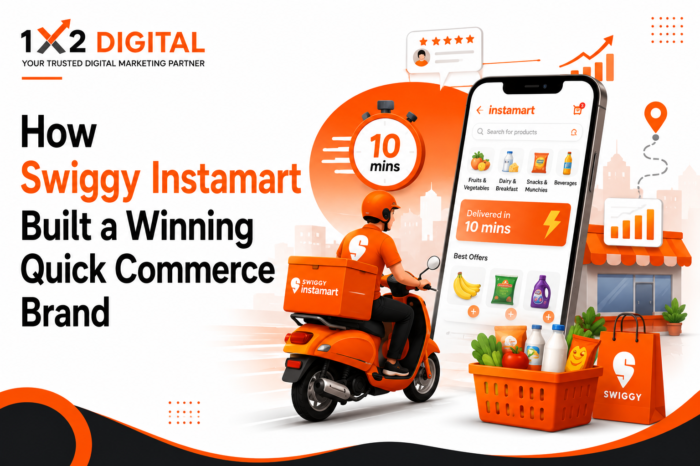
How Swiggy Instamart Built a Winning Quick Commerce Brand
- July 30, 2026
Somewhere between a burglar quietly waiting for a projector to arrive and a customer accidentally trying to order Juhi Chawla instead of chawal, Swiggy Instamart figured out something most quick commerce brands never do: how to make a delivery timer feel like personality.
Every player in India’s quick commerce race is selling roughly the same promise, groceries and essentials at your door in minutes. What separates Instamart is that it turned that operational fact into a brand people actually talk about, even after regulators told the category to stop advertising the number that built it.
In short: Swiggy Instamart built a winning quick commerce brand by turning “10-minute delivery” from a logistics claim into a consistent brand promise, backing it with humour-led advertising that made the category memorable rather than purely functional, and pairing that brand narrative with aggressive dark-store expansion and a widening product assortment. When regulation forced it to drop the explicit “10 minutes” language, the brand had already built enough recall and loyalty to shift its messaging without losing category ownership. It’s now moving that same brand momentum toward profitability, focusing on higher-value customers instead of pure user growth.
Fast Facts
| Category | Quick commerce (groceries, household essentials, and an expanding non-grocery assortment) |
| Core brand promise | Ultra-fast delivery, originally marketed around a “10-minute” claim |
| Dark store network | Expanded to 1,143 active dark stores by Q4 FY26 |
| Creative partner | Moonshot (agency behind Instamart’s humour-led ad campaigns) |
| Notable campaigns | ‘Big or Small, We Deliver It All’ (burglar comedy film), Juhi Chawla digital film, scented mango print ad, Rohit Sharma’s ‘Yeh Se Leke Woh Tak’, ICC CWC 2023 adaptive billboard |
| Regulatory shift | Union Labour Ministry directed quick commerce platforms to stop explicitly promoting “10-minute” service claims (January 2026) |
| Business pivot | Deliberately reducing dependence on low-Average-Order-Value users to focus on high-frequency, high-spend customers |
What Made Swiggy Instamart’s Quick Commerce Strategy Work?
Instamart’s strategy worked because it treated speed as a brand identity rather than just an operational metric, and then built the infrastructure, dark stores, assortment and logistics, to actually back that identity up rather than let it become an empty promise.
Quick commerce as a category is easy to describe and hard to differentiate in: every competitor promises fast delivery of everyday items. Instamart’s approach was to pick one number, commit to it everywhere, in ad films, in billboards, in packaging language, and let that repetition do the work of building a distinctive brand asset rather than a generic category claim. It’s the same underlying discipline behind good ecommerce conversion rate optimization: pick the one thing your customer values most, and make sure they experience it consistently at every single touchpoint.
How Did Instamart Turn “10 Minutes” Into a Brand Asset?
Instamart elevated “10 minutes” from a delivery specification into a brand promise by repeating it consistently across every campaign format, regardless of the creative concept, so the number itself became instantly recognisable rather than just a technical detail buried in the app.
This is a subtle but important distinction. An operational specification tells a customer a fact. A brand promise tells them what to expect and holds the brand accountable to it every single time. By anchoring campaign after campaign, comic films, cricket-tie-ins, print executions, to the same number, Instamart made “10 minutes” function the way a tagline would for another brand, giving the category a mental shortcut that competitors had to react to rather than define on their own terms.
What Role Did Humour-Led Advertising Play in Building the Brand?
Humour-led advertising gave Instamart a way to make a purely functional promise, speed, feel entertaining and shareable, which helped the brand stay in conversation even in a category where every competitor is selling nearly the same thing.
A few campaigns illustrate the range of this approach:
- ‘Big or Small, We Deliver It All’: A film built around burglars who end up helping around the house while waiting on deliveries, using comedy to showcase Instamart’s expanded assortment of over 35,000 products, from home appliances to K-beauty, without a single dry product list
- The Juhi Chawla digital film: A wordplay-driven ad where a customer meant to type “chawal” (rice) but typed “Chawla” instead, turning a search-bar mistake into a memorable, quotable moment
- The scented mango print ad: An execution that let readers literally smell the ad, an example of the brand looking for sensory, talkable ideas even in a traditional format like print
- Rohit Sharma’s ‘Yeh Se Leke Woh Tak’ and the ICC CWC 2023 adaptive billboard: Campaigns that borrowed cricket’s cultural weight in India to place Instamart’s speed promise inside a moment audiences were already emotionally invested in
The common thread across all of these is that none of them lead with a discount or a feature list. They lead with a story, and let the brand promise sit inside it.
How Is Instamart Scaling Operations Behind the Brand Story?
Behind the advertising, Instamart backed its speed promise with real infrastructure investment, expanding its dark store network and widening its product assortment so the brand promise could actually hold up at scale rather than just looking good in a campaign.
- Dark store expansion: The network grew to 1,143 active dark stores by the fourth quarter of FY26, extending reach well beyond metro cities
- Assortment strategy: Initiatives like Megapods and Maxsaver have been used to widen the range of SKUs available and encourage larger basket sizes, moving the brand beyond a narrow grocery-only identity
- Category expansion: The catalogue has grown to include electronics, personal care, fashion and other non-grocery essentials, supporting the ‘we deliver it all’ brand narrative rather than contradicting it
This matters because a brand promise that isn’t operationally true eventually breaks trust. Instamart’s marketing worked partly because the delivery experience largely lived up to what the ads claimed. Smaller ecommerce brands rarely have a dark-store network to invest in, but the equivalent backend work usually sits in Shopify conversion rate optimization, page speed, checkout steps and mobile experience, since that’s what actually decides whether a strong ad turns into a completed order.
What Happened When Regulation Challenged the Core Promise?
In January 2026, the Union Labour Ministry directed quick commerce platforms to stop explicitly promoting the “10-minute” service claim, which forced Instamart to rethink the exact language it had spent years building its brand around.
This is where a strong existing brand made the difference. A category newcomer forced to drop its defining claim overnight would likely lose the recall it had built. Instamart, by contrast, had already layered enough brand equity, through its ad campaigns, its cultural tie-ins and its consistent tone, that the underlying promise of speed and convenience could survive even after the specific number could no longer be advertised outright.
It’s a useful reminder for any brand built around a single hero claim: the claim gets you attention, but the tone, story and consistency around it are what let the brand survive if that specific claim is ever regulated, disproven or copied by competitors.
How Is Instamart Shifting From Growth to Profitability?
Instamart is deliberately moving away from chasing raw user growth and toward retaining higher-spending, higher-frequency customers, a shift the company has openly attributed to improving unit economics rather than maximising sign-ups.
A few data points make this shift visible:
- The pace of new customer additions has slowed sharply, from adding nearly 3 million users a quarter at its peak to roughly 0.5 million more recently, a change the company has described as intentional
- Leadership has publicly stated it is reducing dependence on low-Average-Order-Value customers, many of whom also use competing platforms and contribute little loyalty either way
- Contribution margins have been improving quarter over quarter, even as adjusted EBITDA losses remain, suggesting the shift toward high-value customers is starting to show in the numbers
This is a mature-brand move: once category awareness is largely won, the smarter growth lever is customer value, not customer count. For most ecommerce businesses without Instamart’s scale, the equivalent lever is usually simpler to act on: learning how to increase conversion rate on the traffic already arriving at the store, rather than only spending more to bring in new visitors.
What Can Other Brands Learn From Instamart’s Playbook?
Businesses across categories, not just quick commerce, can borrow from Instamart’s core lesson: pick one distinctive brand promise, make it entertaining rather than purely functional, and build the operational reality to support it before regulation, competition or customer scrutiny tests whether the promise actually holds.
- Anchor to one number or promise, and repeat it everywhere. A specific, ownable claim beats a vague positioning statement, provided the brand can actually deliver on it consistently
- Use humour to carry a functional message. A speed or convenience claim on its own is forgettable; wrapped inside a story people want to share, it travels much further
- Match brand ambition with backend investment. Advertising a promise the operations can’t support is a short-term win and a long-term trust problem
- Plan for the day the hero claim gets challenged. Regulatory change, a competitor catching up, or simply market maturity can force a brand to drop its signature line; the brands that survive that moment are the ones with enough built-up equity around tone and story to fall back on
- Know when to shift from growth to value. Chasing volume works early; retaining the right customers profitably is what determines who’s still standing once the category matures
None of this requires Instamart’s scale to apply. A regular Shopify or ecommerce store can borrow the same logic through disciplined conversion rate optimization, ecommerce, in this case, is just a smaller, faster version of the same funnel Instamart spent years engineering.
In Conclusion
Swiggy Instamart’s quick commerce story isn’t really about being the fastest, most quick commerce apps now deliver in a similar window. It’s about how deliberately the brand turned that speed into something people would actually notice, laugh at, and remember, and how much operational investment sat quietly behind every ad film to make sure the promise held up.
The regulatory pushback on “10-minute” messaging could have been a serious setback for a weaker brand. For Instamart, it became a test of how much brand equity had actually been built beyond the number itself, and so far, the brand has adjusted its language without losing its position.
If your brand is trying to build that same kind of recall, a promise strong enough to survive a regulatory change, a competitor’s copycat move, or simple market saturation, that’s exactly the kind of brand and growth strategy work 1into2 helps businesses think through, whether that means a broader brand narrative or hands-on conversion rate optimization services in India for the funnel underneath it. As a full-service digital marketing agency in Rajkot, we help brands build both. Reach out at info@1into2.com and let’s build a brand story that holds up under pressure, not just under a campaign brief.
FAQs
1. What made Swiggy Instamart’s marketing different from other quick commerce brands?
Instamart consistently turned its 10-minute delivery promise into an entertaining brand story through humour-led campaigns, rather than only communicating speed as a technical feature.
2. Why did Swiggy Instamart have to stop promoting “10-minute delivery”?
The Union Labour Ministry directed quick commerce platforms in January 2026 to stop explicitly advertising the “10-minute” service claim, prompting Instamart to adjust its messaging while retaining its broader speed-and-convenience positioning.
3. How many dark stores does Swiggy Instamart operate?
Instamart’s dark store network had expanded to 1,143 active locations by the fourth quarter of FY26, supporting its wider delivery footprint across metro and non-metro cities.
4. Why is Instamart focusing on fewer new users instead of growing its user base quickly?
The company has deliberately shifted focus toward retaining higher-spending, higher-frequency customers to improve contribution margins and move closer to profitability, rather than prioritising raw user sign-ups.
5. What can other brands learn from Instamart’s approach?
Brands can learn to build one clear, ownable promise, support it with real operational investment, use storytelling rather than pure functionality to make that promise memorable, and prepare for the possibility that the hero claim may need to evolve over time.
More from our blog
See all posts