Why Zero-Click Searches Are Changing Digital Marketing Forever
- August 3, 2026
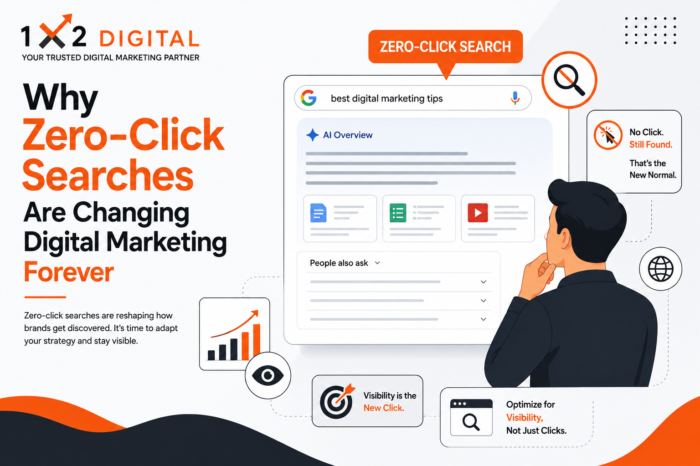
Someone in Ahmedabad searches “best digital marketing agency near me” this morning. Google answers the question, shows a map, three reviews and a phone number, right there on the results page. They never click a single website. Your business either showed up in that box, or it didn’t exist for that search at all.
This is happening to millions of searches every day now, and it’s quietly rewriting the rules that digital marketing has run on for the last two decades.
In short: zero-click searches are queries that get fully answered inside Google’s search results page, through AI Overviews, featured snippets, knowledge panels or local packs, so the user never visits an external website at all. In 2026, roughly 68% of Google searches in the US end this way, up sharply from just under 50% a decade ago. For digital marketing, this means visibility now matters more than clicks: brands need to earn a place inside the answer itself, not just rank on a results page people are increasingly likely to never scroll past. The shift rewards structured, well-built websites and clear expertise over sheer keyword volume, and it’s permanent, not a passing algorithm update.
Fast Facts
| Zero-click search rate (2026) | Around 68% of US Google searches end without a click |
| A decade ago (2019) | Roughly 50% of searches ended without a click |
| Click-through with AI Overview present | About 8%, versus 15% when no AI Overview appears (Pew Research) |
| AI Overview reach | Now triggers on close to half of all tracked search queries |
| Mobile vs desktop gap | Zero-click rates are significantly higher on mobile than desktop |
| Least affected queries | Transactional and ecommerce searches, since users still need to visit a site to actually complete a purchase |
| New discipline emerging | Answer Engine Optimization (AEO), optimizing for inclusion in AI-generated answers, not just page rankings |
What Are Zero-Click Searches?
A zero-click search is any query where Google answers the user’s question directly on the results page, through an AI Overview, featured snippet, knowledge panel or local pack, so the person never needs to click through to any website to get what they came for.
Ten years ago, this was a small slice of search behaviour, mostly simple factual queries like unit conversions or quick definitions. Today it covers a huge share of everyday searches, including many that used to reliably send traffic to business websites: “what time does X close,” “best Y near me,” “how does Z work.” The user’s intent is satisfied before they ever leave Google.
Why Are Zero-Click Searches Increasing So Fast?
Zero-click searches have accelerated sharply because Google’s AI Overviews now trigger on a large share of all queries, and independent research consistently shows that when an AI-generated summary appears, users are roughly half as likely to click through to a website compared to a standard results page.
A July 2025 study by Pew Research Center, tracking close to 69,000 real Google searches, found users clicked through on just 8% of searches when an AI Overview was present, compared to 15% when it wasn’t. That gap, on queries that now cover close to half of all searches, explains most of the recent acceleration.
A few forces are driving this together:
- AI Overviews answer more complex questions than older featured snippets ever could, covering comparisons, explanations and multi-part questions directly on the results page
- Local packs and knowledge panels have matured, so map-based and business-information searches rarely need a click at all
- Mobile search behaviour reinforces the trend, since smaller screens and on-the-go intent make an instant on-page answer even more convenient than tapping through to a separate site
- This is a deliberate product direction for Google, not a side effect, since keeping users inside its own ecosystem for longer serves its own engagement goals
The pattern predates generative AI, featured snippets and knowledge panels were already pushing zero-click rates up years before AI Overviews existed, but AI-generated answers have made the shift far steeper in the last two years.
How Are Zero-Click Searches Changing Digital Marketing Strategy?
Zero-click search is forcing digital marketing to measure success by visibility and citation inside the answer itself, not purely by website clicks and sessions, which means brands now need to optimise for being quoted by an AI Overview as much as for ranking on the page below it.
This has given rise to a discipline often called Answer Engine Optimization (AEO), sitting alongside traditional SEO rather than replacing it.
| Traditional SEO | Answer Engine Optimization (AEO) | |
| Core goal | Rank high on the results page | Get quoted or cited inside the AI-generated answer itself |
| Success metric | Clicks, sessions, rankings | Citation frequency, brand mentions, share of voice inside answers |
| Content style | Can build up to the answer gradually | Needs to state the answer clearly and early |
| Relationship | The foundation AEO still depends on | An additional layer built on top of solid SEO, not a replacement for it |
The practical shift looks like this:
- Clicks are no longer the only success metric. A brand can be cited inside an AI Overview, build authority and trust with a searcher, and never register a single session in analytics
- Content needs to answer the question directly and early, rather than making a reader scroll through introduction paragraphs before getting to the actual answer
- Structured data and clear entity information matter more, since AI systems pull answers from content that’s easy to parse and attribute confidently
- Brand mentions without a click still carry value, appearing inside an AI-generated answer builds recognition and trust even if the user never visits the website that day
Also Read: How to Get Featured in Google AI Mode (Before Everyone Else Does)
What Does This Mean for Local and Service Businesses?
For local and service businesses, zero-click search often means the entire customer decision, discovery, comparison and even contact, happens inside Google’s local pack, so showing up accurately there matters as much as, or more than, driving traffic to the actual website.
Think about how someone actually searches today. A person typing something like “best design agency near me” is frequently shown a local pack with names, ratings, and a map before they ever see a traditional blue link. If a business’s Google Business Profile, reviews and local listings aren’t accurate and complete, it can lose a lead before the searcher even reaches the website, no matter how well the site itself is built.
This makes local SEO fundamentals, business profile accuracy, review volume, consistent listings, more important than ever, since they’re often the only thing a zero-click searcher sees.
Why Do Mobile Searches Behave Differently From Desktop?
Mobile zero-click rates run consistently higher than desktop, because smaller screens and shorter attention spans make an instant on-page answer far more convenient than tapping through to a separate site, which puts extra pressure on how a brand’s mobile experience is built once a click does happen.
This is genuinely good news for brands with a strong mobile presence, but it comes with a catch: it raises the stakes on what happens once a visitor does click through on their phone. A brand investing properly in mobile app interface design that’s fast, intuitive and easy to navigate will retain far more of that surviving mobile traffic than an app or site that feels clunky on a small screen. In a zero-click world, the traffic you do earn is more valuable and less forgiving of a poor experience.
How Should Brands Design Their Websites for the Zero-Click Era?
Websites built for the zero-click era need clean technical structure, clear schema markup and fast load times, since these are exactly the signals AI Overviews and featured snippets rely on to decide which source to summarise, quote or cite.
- Structured data and schema markup help search engines and AI systems understand exactly what a page is about, making it easier to be pulled into an answer
- Clear, well-organised page architecture, proper headings, direct answers early in the content, makes pages easier for both users and AI crawlers to parse quickly
- Site speed and mobile performance continue to influence both traditional rankings and how confidently a page gets cited in an AI-generated summary
Getting this right usually isn’t a one-person job. It’s the kind of structural work that good user interface design handles as part of a site build, not something bolted on afterward through a plugin.
Businesses researching user interface design online before a rebuild or redesign in 2026 should specifically look for guidance on technical SEO and structured data, not just visual layout, since that’s what determines whether the new site actually earns AI visibility or just looks better.
What Can Businesses Do to Stay Visible Despite Zero-Click Search?
Businesses can stay visible in a zero-click world by treating AI Overviews and featured snippets as a distribution channel to win, rather than a threat to fight, focusing on content that directly answers questions, strong local listings, and a website built to earn the clicks that do still happen.
- Write to be quoted, not just to rank. Answer the core question in the first few lines of a page, in plain language an AI system can lift directly
- Keep local listings complete and current. For any business relying on local search, this is often the single highest-leverage fix available
- Build authority signals, not just keywords. Clear expertise, author information and credible sourcing all help content earn a citation inside an AI-generated answer
- Invest in the experience for the clicks you do earn. Since the searchers who do click through today tend to be higher-intent, a fast, well-designed site converts that smaller, better-qualified audience far more effectively
Why the Right Design Partner Matters Now More Than Ever
In a search landscape where every click matters more and every screen needs to work harder to earn AI visibility, choosing the right design partner has become a core part of digital marketing strategy, not a separate decision made after the marketing plan is set.
A capable interface design agency today needs to think beyond visual polish: technical SEO, schema implementation, page speed and mobile performance all directly affect whether a brand survives the zero-click shift or quietly disappears from AI-generated answers altogether.
This holds true even for more complex products. A business evaluating a UI UX design company in India for a feature-rich app or platform needs the same technical foundation, since a slow or poorly structured experience loses AI visibility just as easily as a simple brochure website does.
For growing businesses trying to get this right, the priority should be a team that understands both sides, design and search visibility, rather than treating them as two separate vendors solving two separate problems.
You might also like: What Is Agentic AI and Why Should Your Brand Know About It
In Conclusion
Zero-click search isn’t a temporary side effect of AI Overviews that will fade once the novelty wears off. It’s the direction search has been heading for over a decade, and generative AI has simply accelerated a trend that was already well underway.
The brands that adapt fastest are the ones treating this as a visibility opportunity rather than a traffic problem, showing up accurately in local packs, earning citations inside AI answers, and making sure that when a click does happen, the experience on the other end is fast, well-designed and built to convert.
If you’re figuring out where to start, 1into2 works as a full-service digital marketing agency in Rajkot for exactly this kind of transition, helping brands get genuinely ready for both human and AI-driven discovery. Drop us a line at info@1into2.com and let’s map out where your brand stands today.
FAQs
1. What is a zero-click search?
A zero-click search is a query that gets fully answered on Google’s results page itself, through an AI Overview, featured snippet, knowledge panel or local pack, so the user never clicks through to an external website.
2. How common are zero-click searches in 2026?
Around 68% of Google searches in the US now end without a click, up from roughly 50% a decade ago, with the steepest increase coming in the last two years as AI Overviews expanded.
3. Why does mobile experience matter more in a zero-click world?
Mobile zero-click rates are higher than desktop, so the traffic that does click through on mobile tends to be higher-intent, which makes fast, well-built mobile app interface design essential for converting that smaller, more valuable audience.
4. What is Answer Engine Optimization (AEO)?
AEO is the practice of optimising content to be included, quoted or cited inside AI-generated answers and summaries, rather than optimising purely to rank on the traditional results page below them.
5. How can a business stay visible if fewer searches lead to clicks?
By writing content that directly and clearly answers common questions, keeping local business listings accurate and complete, and building a website with strong technical SEO and structured data so it’s easier for both users and AI systems to find and trust.
More from our blog
See all posts