Education Facebook Ads: How to Reach More Students and Generate Leads
- October 29, 2026
Introduction
Every educational institution wants to reach the right students, increase admissions, and build trust with parents. However, attracting students through traditional marketing methods can be costly and time-consuming. This is where education Facebook ads can make a real difference.
Schools, colleges, coaching institutes, and online educators can use Facebook ads to promote specific courses, share admission updates, and collect enquiries from relevant audiences in their target locations, subject to Meta’s audience-targeting and advertising policies. With the right strategy, you can promote your courses, answer common questions, and encourage interested people to contact your admission team.
But running ads is not just about spending money and getting clicks. The real goal is to attract students who are genuinely interested in your courses and turn that interest into admission enquiries.
In this guide, you will learn how to plan effective Facebook ad campaigns, improve lead quality, promote online classes, and generate more educational enquiries without wasting your marketing budget.
Why Education Facebook Ads Matter for Student Admissions
Students and parents often explore different educational options before making a decision. They compare course fees, teaching quality, class schedules, placement support, and learning opportunities.
Facebook advertising helps educational businesses reach these potential students while they are discovering their options.
Here are some key benefits:
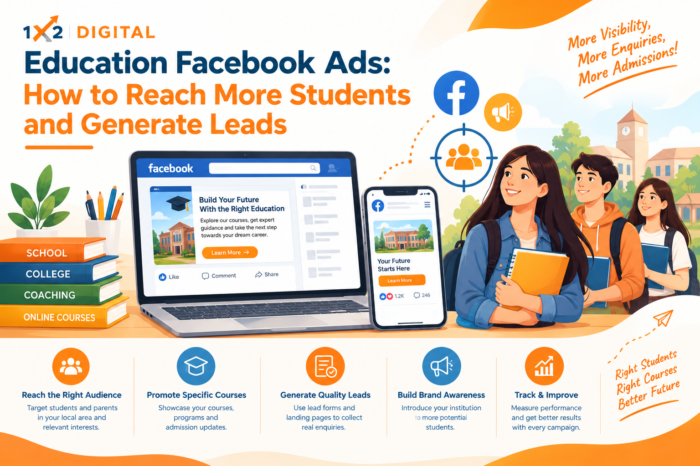
- Reach the right audience: Show your courses to people in your target locations and relevant age groups.
- Promote specific courses: Advertise entrance exam preparation, professional courses, school admissions, or online learning programmes.
- Generate direct enquiries: Use lead forms, website landing pages, or messaging options to collect student enquiries.
- Build awareness: Introduce your institution to people who may not know about your courses yet.
- Measure campaign performance: Track clicks, enquiries, cost per lead, and other available campaign metrics.
For example, a coaching institute in Rajkot can create a campaign for students interested in entrance exam preparation within its service area. Instead of promoting every course in one advertisement, it can create separate campaigns for different courses and audiences.
This makes the message more relevant and helps the institution understand which offers attract genuine interest.
How to Create Facebook Advertising for Schools That Attracts Students
Successful facebook advertising for schools starts with a clear message and a well-planned audience. Simply uploading a poster and boosting it may generate views, but it does not always bring quality admission enquiries.
Use these steps to build a stronger campaign.
1. Decide What You Want Your Campaign to Achieve
Before creating an advertisement, identify your main goal.
Do you want to increase school admission enquiries, promote a new course, fill seats in a coaching batch, or encourage students to book a counselling session?
Your campaign objective should match the action you want people to take.
For example, if your goal is to collect admission enquiries, choose a suitable lead-generation objective. If you want students to explore course details on your website, a website-focused campaign may be more appropriate.
A clear goal also makes it easier to measure whether your advertising is working.
2. Understand the Students and Parents You Want to Reach
Not every student is looking for the same educational opportunity.
A school may need to reach parents, while a competitive exam institute may focus on eligible students and their families. An online course provider may target learners who want to develop specific professional skills.
Consider these factors when planning your audience:
- Location and service area
- Relevant age groups and eligibility
- Course interests and learning goals
- Language preferences
- Previous interactions with your institution
Use Meta’s available audience and targeting options, while following applicable advertising policies. For campaigns involving minors or sensitive education-related circumstances, review the relevant restrictions carefully.
The more closely your advertisement matches the needs of your intended audience, the more useful your enquiries are likely to be.
3. Write an Advertisement That Answers a Real Question
Students rarely enquire about a course simply because an advertisement looks attractive. They want to know how the course can help them.
Your ad copy should explain the value of the course in clear, everyday language.
For example:
Headline: Looking for the Right Course After Class 12?
Ad copy: Explore our available courses, learn about the admission process, and speak with our counselling team to understand your options.
Call to action: Enquire Now
Avoid unrealistic promises such as guaranteed jobs, guaranteed exam results, or assured admissions unless the claims are genuinely supportable and permitted. Clear and honest advertising builds stronger trust with students and parents.
4. Use Visuals That Make Your Institution Feel Trustworthy
Your creative design is often the first thing a potential student notices.
Use genuine classroom photographs, faculty introductions, course demonstrations, campus videos, or student testimonials that you have permission to publish.
Make sure your design communicates one main message instead of filling the image with too much text.
For example, a school admission campaign could highlight its learning environment, teaching approach, and admission enquiry process. A digital skills course could show what students will learn and which practical projects they will complete.
Good visuals should help people understand your educational offering, not distract them from it.
Education Lead Generation Companies: How to Choose the Right Partner
Many institutions struggle to generate consistent enquiries even after spending money on advertising. The problem may not be the advertising platform itself. It could be the audience, campaign structure, landing page, or follow-up process.
This is why some institutions consider working with education lead generation companies or a specialised digital marketing team.
Before choosing a partner, evaluate these important factors.
Look Beyond the Number of Leads
A campaign that generates hundreds of enquiries may still perform poorly if most people are not interested in the course.
Ask the agency how it measures lead quality. Useful metrics include:
- Total enquiries generated
- Cost per lead
- Percentage of valid enquiries
- Number of students who meet admission requirements
- Counselling appointments booked
- Admissions generated from advertising
These figures provide a clearer picture of whether your marketing investment is delivering value.
Check Whether the Agency Understands Education Marketing
Education marketing requires a different approach from promoting everyday consumer products.
Students and parents often need information, reassurance, and time before making a decision. A good agency should understand admission cycles, course-specific audiences, parent concerns, and the importance of timely follow-ups.
Ask about its campaign planning process, reporting methods, and experience with similar educational businesses.
Keep Control of Your Advertising Data
Your institution should have appropriate access to its advertising account, campaign reports, lead information, and tracking setup.
Agree on lead ownership, reporting frequency, privacy practices, and the responsibilities of both parties before starting the campaign.
A transparent partnership makes it easier to understand what is working and improve future campaigns.
Online Classes Ads: How to Promote Courses and Get More Enquiries
Online education gives students the flexibility to learn from different locations. However, students have many options, so your advertisement needs to explain why your course deserves their attention.
Effective online classes ads focus on the learning experience, course benefits, and the next step a student should take.
Show What Students Will Actually Learn
Instead of writing only “Join Our Online Classes,” highlight the course topic, teaching format, and practical benefits.
For example:
- Learn essential Excel skills through guided practice.
- Prepare for competitive exams with structured lessons.
- Develop digital marketing skills through practical assignments.
- Improve spoken English with regular guided sessions.
Use benefits that accurately reflect your course.
Offer a Useful First Step
You can encourage potential students to explore your teaching approach through a free introductory session, sample lesson, course outline, or counselling call, if your institution offers these options.
This gives students a better understanding of what they can expect before enrolling.
Make the offer clear in the advertisement and explain any relevant conditions.
Create a Simple Enquiry Process
When students click your advertisement, they should quickly understand what to do next.
A useful landing page or lead form can include:
- Course name
- Course duration and format
- Basic eligibility requirements
- Available learning options
- Contact details or an enquiry form
Ask only for the information you need to respond to the enquiry. A shorter, relevant form can make it easier for interested students to contact your institution.
Online Course Advertising: Turn Interest Into Enrolments
Generating leads is only one part of a successful campaign. Your institution also needs a process that helps potential students move from initial interest to enrolment.
Effective online course advertising combines relevant ads, useful course information, and consistent communication.
Match Your Ad Message With Your Landing Page
Suppose your advertisement promotes a beginner-level digital marketing course. When users click it, they should arrive at a page that explains that exact course.
If the landing page contains unrelated programmes, unclear pricing, or missing course details, potential students may leave without enquiring.
Keep the message consistent from the advertisement to the landing page.
Follow Up With Interested Students Promptly
A student may enquire about several courses within a short period. If your institution responds too late, the student may choose another provider.
Create a simple follow-up process:
- Record the enquiry and the course of interest.
- Contact the student using their preferred, permitted communication channel.
- Answer questions about fees, schedules, eligibility, and course content.
- Offer a counselling session or next step where appropriate.
- Record the outcome for future campaign analysis.
Follow-up messages should be relevant and respectful. Obtain and manage consent where required, and provide an appropriate way to opt out of marketing communications.
Measure Enrolments, Not Just Clicks
Clicks show that people interacted with your advertisement. Leads show that people expressed interest. Neither metric alone proves that the campaign generated admissions.
Track the journey from the first enquiry to the final enrolment wherever practical.
This helps you identify which courses, campaigns, and audiences bring the most valuable results.
How to Reduce the Cost of Education Facebook Ads
Advertising costs can increase when campaigns target the wrong audience, use unclear messaging, or send visitors to a confusing website.
Although no strategy can guarantee a particular cost per lead, several practical improvements can help you use your budget more effectively.
Test Different Ad Creatives
Create a small set of advertisements with different headlines, visuals, or course benefits.
For example, one ad could introduce the faculty, another could explain the course structure, and a third could promote an upcoming information session.
Compare performance using meaningful metrics such as qualified enquiries and cost per qualified lead, rather than choosing a winner based only on clicks.
Improve Your Lead Form
Ask for essential information, such as a name and a suitable contact method. Add course-related questions only when they help your team respond appropriately.
Avoid collecting unnecessary personal information. Test the form on mobile devices and make sure the submission process works correctly.
Review Your Campaign Regularly
Check which advertisements generate useful enquiries and which spend money without delivering meaningful results.
Review audience relevance, creative performance, lead quality, and follow-up outcomes before making changes.
Avoid changing too many variables at once, as this can make it difficult to identify the reason for improved or reduced performance.
Why an Experienced Digital Marketing Agency Can Help
Managing educational advertising requires planning, creative development, campaign monitoring, and lead tracking. Institutions with limited internal marketing resources may benefit from professional support.
A suitable agency can help with:
- Audience and competitor research
- Campaign strategy and budget planning
- Ad copy and creative development
- Landing page recommendations
- Conversion tracking and reporting
- Lead quality analysis
- Ongoing campaign improvements
If your institution operates in Gujarat, you may also consider local agencies that understand the regional market and the needs of educational businesses.
For example, an institution searching for a digital marketing agency in Rajkot may prefer a team that can understand its local audience, admission goals, and course offerings.
Similarly, businesses evaluating the best digital marketing agency in Ahmedabad should compare education-sector experience, reporting transparency, communication, and measurable results rather than relying on promotional claims alone.
The right partner should explain its strategy clearly and help your institution make informed marketing decisions.
Common Mistakes to Avoid in Education Facebook Ads
Even a well-designed campaign can struggle when basic details are overlooked.
Watch out for these common mistakes:
Targeting too broad an audience: Advertising to people who are unlikely to qualify for or need the course can reduce lead quality.
Using unclear offers: Students should understand the course, its benefits, and the next step without guessing.
Ignoring mobile users: Forms and landing pages should load properly and remain easy to use on smaller screens.
Collecting leads without follow-up: Enquiries lose value when the admission team does not respond consistently.
Measuring only cost per lead: Cheap enquiries are not necessarily valuable enquiries. Track lead quality and enrolments as well.
Making unsupported claims: Avoid misleading statements about results, salaries, placements, or guaranteed admissions.
Ignoring platform policies: Review current Meta advertising policies and applicable privacy requirements before launching campaigns.
Avoiding these mistakes gives your institution a stronger foundation for sustainable student acquisition.
Final Thoughts
Education marketing works best when the right students receive the right information at the right time. Well-planned education Facebook ads can help institutions introduce their courses, attract relevant enquiries, and build a more organised admission process.
The key is to focus on more than clicks. Understand your audience, communicate real course benefits, create a simple enquiry journey, and follow up consistently. Then use campaign data to identify what works and improve what does not.
Whether you run a school, coaching centre, training institute, or online education business, a clear strategy can help you make better use of your advertising budget and build stronger connections with potential students.
If you need professional support, consider working with a digital marketing team that understands your educational goals and focuses on transparent reporting, relevant leads, and measurable growth.
FAQs
1. How can schools use Facebook ads to increase admissions?
Schools can use Facebook ads to reach relevant parents, promote admission dates, and highlight their facilities and teaching approach. A clear call to action and a simple enquiry form can encourage interested parents to contact the school.
2. How do I create effective Facebook ads for school admissions?
To create effective Facebook ads for school admissions, use attractive images, clear ad copy, and a strong call to action such as “Apply Now” or “Enquire Today.” Target parents in your school’s local area and highlight key benefits, admission dates, and facilities. Use a simple enquiry form and follow up promptly to turn interested parents into admission leads.
3. How to generate leads for education?
To generate leads for education, use Facebook ads to reach relevant students and parents, promote your courses with attractive visuals, and highlight key benefits. Create simple enquiry forms or landing pages to collect contact details. Share useful educational content, offer free counselling sessions, and follow up with interested students promptly to convert enquiries into admissions.
4. How do I advertise my online course?
To advertise your online course, use Facebook ads to reach students interested in your subject. Create attractive visuals, highlight the course benefits, and include a clear call to action like “Enroll Now.” You can also offer a free demo class, use a simple landing page to collect leads, and follow up with interested students to increase enrolments.
5. How do beginners run Facebook ads for educational institutions?
Beginners can start by choosing a clear campaign goal, such as generating student enquiries or promoting admissions. Create simple ads with relevant visuals, select an appropriate audience, and use a clear call to action. Start with a manageable budget, monitor lead quality and campaign costs, and improve the ads based on actual results.
More from our blog
See all posts