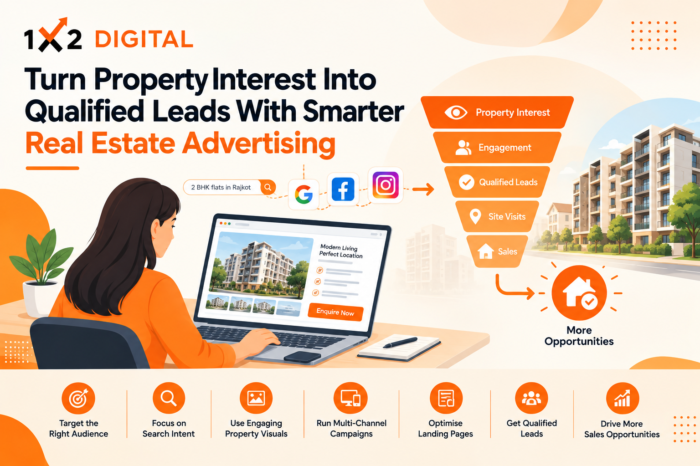
Turn Property Interest Into Qualified Leads With Smarter Real Estate Advertising
- September 21, 2026
Introduction
Buying a property is rarely an instant decision. Today, buyers usually begin by searching online, comparing locations, checking prices, exploring amenities, watching property videos, and researching different projects before contacting a real estate business.
This makes Real Estate Advertising an important part of the modern property-buying journey. But successful advertising is not simply about getting more clicks or increasing impressions. The real objective is to reach relevant prospects, build interest, and guide them towards genuine enquiries, site visits, and meaningful sales conversations.
Key Takeaway: Smart real estate advertising connects the right property with the right audience at the right stage of their buying journey.
Why Real Estate Advertising Needs a Smarter Approach
Real estate buyers do not all have the same level of intent. Someone discovering a new residential project may need basic information, while another person searching for a specific apartment in a particular location may already be close to making a decision.
That is why property campaigns should be planned around the buyer journey instead of showing the same advertisement to everyone.
| Buyer Stage | What the Buyer May Need | Advertising Focus |
| Discovery | Awareness of available properties | Reach and visibility |
| Research | Property details and information | Features, location and benefits |
| Consideration | Reasons to shortlist the property | Strong messaging, visuals and proof |
| Decision | A simple next step | Enquiry, call or site visit |
| Re-engagement | A reason to return | Retargeting and relevant reminders |
This approach allows advertisers to match the message with the buyer’s mindset rather than treating every click as an immediate sales opportunity.
Start With the Search Intent Behind Property Enquiries
A property search can reveal a lot about what a potential buyer is looking for. Someone searching for “2 BHK flats in Rajkot” has a different intent from someone searching for “new residential project near [location].”
This is where Google Ads Real Estate campaigns can become more effective when they are organised around genuine search behaviour.
Campaigns can be structured around:
- Property type and location
- Apartments or homes in specific areas
- Configuration-based searches such as 2 BHK or 3 BHK
- New residential projects
- Premium or luxury properties
- Commercial property searches
- Property price-related searches
- Site visit and enquiry-related searches
The objective is not to target every possible keyword. It is to identify searches that have a meaningful connection with the property being promoted.
Keep the Advertisement Connected to the Property
A common problem in property advertising is the gap between what an advertisement promises and what the landing page actually provides.
A stronger journey looks like this:
Search → Advertisement → Property Page → Enquiry → Sales Follow-Up
If an advertisement highlights a property’s location, configuration or amenities, the landing page should immediately provide relevant information about those same points.
This consistency can reduce confusion and make it easier for an interested visitor to take the next step.
Use Facebook Ads for Real Estate to Build Property Interest
Not every potential buyer is actively searching for a property at the exact moment an advertisement reaches them. Some may discover a project while browsing social media and become interested after seeing the right property, location or lifestyle message.
This is where Facebook Ads for Real Estate can complement search advertising.
Real estate businesses can use social campaigns to showcase:
- Property images and short videos
- Project amenities
- Interior and exterior highlights
- Location advantages
- Nearby infrastructure
- Lifestyle-focused property content
- Construction or project updates
- Offers or enquiry opportunities
- Site-visit information
The creative should also change according to the audience stage.
For example, a person seeing a project for the first time may respond better to a visual introduction, while someone who has already visited the property page may need a more specific reminder or site-visit message.
Use Property Visuals That Help Buyers Explore Before They Visit
Real estate is highly visual. Before scheduling a site visit, buyers often want to understand what the property looks like, how the spaces are arranged, what amenities are available, and what the surrounding area offers.
Good advertising therefore needs more than a headline and a contact form.
Depending on the property, businesses can use:
- Professional property photography
- Short walkthrough videos
- Virtual tours
- Floor plans
- Interior and exterior visuals
- Amenity photographs
- Location and neighbourhood videos
- Construction progress visuals
These assets can work across advertisements, property pages, social media and remarketing campaigns.
The journey becomes more useful when the advertisement creates interest, visual content helps the buyer explore, and the landing page provides the information needed to make an enquiry.
Build Real Estate Ad Campaigns Around Different Properties
A single advertising approach may not work equally well for every type of property. The information that matters to an apartment buyer can be very different from what attracts a commercial property investor.
Real Estate Ad Campaigns can therefore be organised according to property type and buyer requirements.
| Property Type | Messaging Focus |
| Apartments | Configuration, location, amenities and lifestyle |
| Luxury Properties | Design, premium features and experience |
| Commercial Property | Location, accessibility and business suitability |
| Plots | Location, development and surrounding infrastructure |
| Rental Properties | Availability, convenience and location |
This segmentation also makes campaign performance easier to understand. Businesses can identify which property categories, audiences and messages are generating meaningful enquiries rather than simply measuring total clicks.
Promote Properties Across the Right Digital Channels
A property does not necessarily need to depend on a single advertising platform. Different channels can contribute at different points in the buyer journey.
A well-planned campaign may combine:
- Google Search campaigns
- Facebook and Instagram advertising
- Property listing platforms
- Website property pages
- Email campaigns
- Google Business Profile visibility
- Remarketing campaigns
- Organic search traffic
The important part is not being present everywhere. It is selecting channels that match the property’s audience and marketing objective.
For example, search advertising can capture active demand, while social media can introduce a project to potential buyers who may not yet be searching. Email can help businesses stay connected with existing enquiries, while remarketing can bring previous visitors back into the consideration process.
Don’t Depend Only on Paid Advertising for Property Visibility
Paid advertising can generate immediate visibility, but property marketing can also benefit from organic search traffic.
Well-optimised property pages can capture people searching for specific locations, property types, configurations, projects or neighbourhood information.
A useful property page should have:
- A clear and descriptive page title
- Accurate property information
- Location details
- Configuration and amenities
- Relevant images and videos
- Useful FAQs
- Clear enquiry options
- Relevant internal links
- Easy-to-understand calls to action
This creates another path for potential buyers to discover the property without relying entirely on paid campaigns.
Turn Clicks Into Qualified Leads
Getting a large number of enquiries may look positive on the surface, but lead volume alone does not determine campaign quality.
A real estate business ultimately needs prospects who have a genuine connection with the property.
For example, an enquiry may not be useful if the person:
- Is looking in a completely different location
- Has a budget far below the property’s price range
- Is searching for a different property type
- Is not currently planning to buy
- Is only looking for general information
A more meaningful measurement journey is:
Ad Clicks → Enquiries → Qualified Leads → Site Visits → Sales Conversations
This helps marketing and sales teams understand whether advertising is producing genuine opportunities rather than simply increasing lead numbers.
Make the Landing Page Work as Hard as the Advertisement
Once a prospect clicks an advertisement, the landing page becomes an important part of the conversion process.
A property landing page should quickly answer the questions a potential buyer is likely to have.
Depending on the project, this can include:
- Property type
- Location
- Available configurations
- Key amenities
- Property highlights
- Relevant pricing information
- Project information
- Images and videos
- Location advantages
- Enquiry form
- Call or WhatsApp option
- Site-visit request
The page should make the next action clear.
A strong advertisement can create interest, but the landing page needs to turn that interest into an actionable enquiry.
Retarget People Who Have Already Shown Interest
Real estate decisions often take time. A visitor may explore a property page today but not be ready to enquire immediately.
Retargeting allows businesses to reconnect with people who have already interacted with their digital presence.
Depending on the campaign setup, audiences can include:
- Property-page visitors
- Website visitors
- Video viewers
- Social media engagers
- Previous leads
- People who started but did not complete an enquiry
The message can also change based on previous behaviour.
Someone who viewed a property page may receive a reminder about the project, while someone who already submitted an enquiry may receive a different message focused on scheduling a site visit.
This makes retargeting more relevant than repeatedly showing the same advertisement to everyone.
Use Local Information to Make Property Advertising More Relevant
Location plays a major role in real estate decisions. Buyers are not only evaluating the property itself; they are also considering the area around it.
Advertising and property content can therefore highlight useful local information such as:
- Nearby roads and transportation
- Schools and educational institutions
- Hospitals and healthcare facilities
- Shopping and entertainment options
- Business districts
- Important landmarks
- Upcoming infrastructure
- Lifestyle advantages of the neighbourhood
This information can also support organic search visibility by creating useful location-specific content around the property.
The key is to provide information that helps the buyer understand the location rather than simply repeating promotional claims.
Measure What Actually Matters
Real estate campaigns can generate large amounts of performance data, but not every metric has the same business value.
Instead of looking only at impressions and clicks, businesses should track metrics such as:
- Qualified leads
- Cost per qualified lead
- Enquiry conversion rate
- Enquiry-to-site-visit rate
- Number of site visits
- Sales conversations
- Campaign conversion rate
- Performance by property type
- Performance by audience and location
These insights can reveal which properties, audiences, messages and channels are generating stronger opportunities.
For example, one campaign may generate a lower cost per lead but produce fewer qualified prospects, while another may generate fewer enquiries but a higher proportion of site visits. Looking at the complete journey gives a more useful picture of campaign performance.
When a Real Estate Advertising Agency Can Help
Managing real estate advertising effectively involves more than launching campaigns. Businesses need to understand their audience, choose suitable channels, develop relevant creative, optimise landing pages and connect marketing data with sales outcomes.
A Real Estate Advertising Agency can support areas such as:
- Audience and market research
- Campaign planning
- Google and social media advertising
- Property-focused creative strategy
- Landing page optimisation
- Retargeting
- Lead tracking
- Conversion optimisation
- Campaign performance analysis
The real value comes from connecting these activities instead of treating each one as a separate marketing task.
For businesses looking for a Digital Marketing Agency in Rajkot or exploring a Best Digital Marketing Agency in Ahmedabad, the focus should be on finding a partner that understands both digital acquisition and the conversion journey behind it.
A Natural Digital Marketing Partner
For a real estate business, digital marketing should not stop when someone clicks an advertisement. The complete journey—from audience targeting and campaign messaging to landing-page experience, lead quality and follow-up—needs to work together.
1into2 Digital approaches digital marketing with attention to audience targeting, campaign performance, conversion-focused experiences and measurable business growth.
The objective is simple: create a connected digital journey that helps businesses move from online visibility to meaningful customer enquiries and sales opportunities.
Turn Property Interest Into Real Opportunities
Modern property buyers have access to more information and more choices than ever before. Simply putting a property advertisement in front of a large audience is therefore not enough.
Effective Real Estate Advertising combines search intent, audience targeting, strong property visuals, relevant creative, multichannel promotion, useful landing pages, organic visibility, retargeting and meaningful performance measurement.
The goal is not just to generate another click or collect another form submission.
It is to create a structured journey:
Discover → Explore → Consider → Enquire → Visit → Sales Conversation
When each stage is planned carefully, property advertising becomes more than a visibility exercise. It becomes a practical system for turning genuine property interest into qualified business opportunities.
FAQs
1. What is Real Estate Advertising?
Real Estate Advertising is the promotion of properties, projects, plots, commercial spaces or real estate services through digital and traditional marketing channels. Digital campaigns can include search advertising, social media advertising, property listing platforms, remarketing and website-based promotion.
2. How can Google Ads help real estate businesses?
Google Ads can help real estate businesses reach people who are actively searching for relevant properties, locations or project-related information. Campaigns can be structured around search intent, location, property type and other relevant requirements.
3. Can Facebook Ads generate real estate leads?
Yes. Facebook and Instagram advertising can help real estate businesses reach potential buyers based on audience characteristics and online behaviour. Strong visuals, relevant messaging and a clear enquiry path can help turn social media interest into leads.
4. Why are qualified leads important in real estate?
Qualified leads are more closely aligned with the property’s location, type, budget and buying requirements. Tracking qualified leads helps businesses understand whether advertising is creating genuine sales opportunities rather than simply generating high enquiry volumes.
5. What should a real estate landing page include?
A real estate landing page should provide important property information such as location, configuration, amenities, images, relevant pricing information, project highlights and an easy way to enquire or schedule a site visit.
More from our blog
See all posts