From Scrolling to Dining: How Social Media Marketing for Restaurants Drives More Customers
- September 23, 2026
Introduction
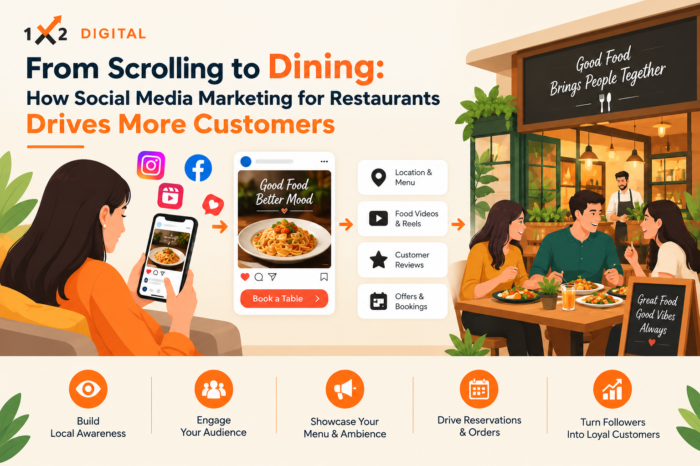
A customer may discover a restaurant while scrolling through Instagram, stop at a Reel showing a signature dish, check the profile, read a few comments, and decide where to eat—all within a few minutes.
That is how the modern restaurant discovery journey often begins. Social media is no longer simply a place to upload food photographs. It can influence how customers discover a restaurant, evaluate the experience, decide to visit or order, and eventually return.
But having an Instagram account and posting occasionally is not a strategy. Restaurants need content with a purpose, the right audience, clear calls to action, and a way to measure whether social activity is contributing to real business results.
This is where a well-planned Social Media Marketing for Restaurants strategy can turn everyday scrolling into meaningful customer action.
How Social Media Is Changing the Way Customers Choose Restaurants
Choosing a restaurant is no longer limited to walking past a signboard or asking friends for recommendations. Customers can now explore a restaurant before they ever step inside.
A short video can introduce the food. The profile can show the ambience. Stories can highlight today’s special. Customer posts can provide social proof. The website can provide the menu, location, opening hours, or reservation details.
The journey can look simple:
Discover → Explore → Evaluate → Decide → Visit → Return
Each stage needs different information.
For example, a Reel may create the first impression, while a customer review helps build confidence. A clear menu link can answer practical questions, and a booking or ordering option can remove the final barrier to action.
The objective is therefore not to make every post promotional. It is to build a social presence that gives potential customers enough reasons to move from curiosity to consideration and from consideration to action.
Give Every Social Media Activity a Clear Business Goal
Before creating a content calendar, a restaurant should decide what it wants social media to accomplish.
A new restaurant may need local awareness. An established restaurant may want more reservations, online orders, repeat customers, or attention for a new menu.
A simple goal-based approach can help:
| Business Goal | Suitable Social Activity | Useful Metrics |
| Build local awareness | Reels, local content, collaborations | Reach, profile visits |
| Promote a new menu | Food videos, carousels, Stories | Engagement, menu clicks |
| Increase reservations | Offers, reviews, booking CTAs | Reservations, enquiries |
| Generate online orders | Product-focused posts, offers | Website and order clicks |
| Strengthen loyalty | UGC, customer features, community content | Repeat engagement |
This prevents a common mistake: measuring every restaurant campaign by likes and follower growth.
If the objective is to increase weekend bookings, reservations and enquiries are more meaningful indicators than simply gaining followers. If the goal is to introduce a new dish, menu visits, saves, shares, and customer responses may provide more useful signals.
In other words:
Goal → Content → CTA → Customer Action → Measurement
That should guide the strategy.
Select Platforms According to Your Audience
Being active everywhere does not automatically make a restaurant more visible. It can actually make content management harder when the team is trying to maintain several platforms without a clear purpose.
Instead, identify where the target audience spends time and what type of restaurant experience needs to be communicated.
Instagram: Turn Your Profile Into a Digital Storefront
Instagram is particularly useful for visual storytelling.
Restaurants can use:
- Reels to showcase dishes and experiences
- Stories for daily updates and limited-time offers
- Carousels for menus and recommendations
- Highlights for menus, reviews, location, and FAQs
- Customer posts to show genuine dining experiences
Effective Restaurant Instagram Marketing should answer the questions customers naturally have before visiting:
What do you serve? What does the restaurant look like? Where are you located? What are customers saying? What makes the experience worth trying?
The profile should make finding those answers easy.
Facebook: Build Local Visibility and Community
Facebook can remain useful for restaurants that depend on local families, community groups, events, and repeat customers.
Restaurants can share:
- Events
- Local updates
- Offers
- Customer stories
- Restaurant announcements
- Community activities
The key is to use Facebook for the audience and purpose it serves rather than simply duplicating every Instagram post.
Use Short-Form Video to Show the Restaurant Experience
Short-form video can show things that a static image cannot communicate as effectively.
Show the chef preparing a signature dish. Capture ingredients arriving in the kitchen. Give viewers a quick restaurant tour. Show the atmosphere during a busy evening. Record a customer’s reaction to a new menu item.
The more naturally a customer can imagine the experience, the stronger the content can become.
Build a Content System Instead of Posting Randomly
One of the biggest challenges in Restaurant Social Media Marketing is maintaining variety.
If every post shows a food photograph followed by “Visit us today,” the profile can quickly become repetitive.
A more useful content system is:
Attract → Inform → Connect → Prove → Convert
1. Attract Attention
The first job of some content is simply to stop the scroll.
Consider:
- Signature dishes
- Food preparation videos
- New dish reveals
- Visually interesting combinations
- Relevant short-form trends
- Chef plating videos
The content should give people a reason to pause.
2. Inform Potential Customers
Once someone is interested, help them understand the restaurant.
Content can explain:
- Menu items
- Ingredients
- Portion sizes
- Special menus
- Dining options
- Opening hours
- Location
- Ordering or reservation options
Useful information can turn interest into consideration.
3. Connect With the Audience
People connect with people, not just products.
Show the personalities behind the restaurant:
- Chef stories
- Staff introductions
- Kitchen moments
- Restaurant celebrations
- Customer interactions
- Local community involvement
These details can make the brand feel more familiar and approachable.
4. Prove the Experience
Potential customers naturally want reassurance before trying somewhere new.
Use:
- Customer reviews
- Testimonials
- Tagged posts
- User-generated content
- Customer photographs
- Repeat-customer stories
Always obtain appropriate permission before using customer-generated content.
5. Convert Interest Into Action
Interested customers should know what to do next.
Depending on the goal, the CTA could be:
View the menu. Book a table. Order online. Call us. Visit today. Try the weekend special.
This gives every piece of content a role instead of turning the content calendar into a collection of unrelated posts.
Marketing a Restaurant With Social Media Means Selling the Experience
Food is obviously central to restaurant marketing. But customers are not choosing only a dish—they are also choosing an experience.
A family may care about the atmosphere and seating. Someone planning a date may look at ambience. A group celebrating an occasion may want to know about special arrangements. A customer ordering online may care about convenience and presentation.
That is why Marketing a Restaurant With Social Media should communicate more than what is on the plate.
For example, imagine a restaurant introducing a new pasta dish.
Instead of publishing the same promotional photograph several times, create a connected content sequence:
Reel: Show how the pasta is prepared.
Story: Ask followers which sauce they would choose.
Carousel: Highlight the final dish and key ingredients.
Customer Content: Share a genuine dining experience.
CTA: Encourage customers to visit or reserve a table.
Now the restaurant is not simply advertising a dish. It is building a small story around the experience.
Use Social Media Advertising to Reach the Right Local Audience
Organic content can build visibility over time, while paid campaigns can help restaurants reach specific audiences for particular business objectives.
Social Media Advertising for Restaurants can support campaigns such as:
- New restaurant launches
- New menu introductions
- Weekend promotions
- Festival specials
- Celebration packages
- Local awareness
- Reservation campaigns
- Online ordering
- Retargeting people who previously interacted with the brand
For a restaurant, location matters considerably.
A restaurant serving customers in one neighbourhood does not necessarily need to show every advertisement to people hundreds of kilometres away. The campaign should focus on audiences who can realistically visit, order, or engage with the business.
A practical advertising process is:
Audience → Location → Creative → Offer → CTA → Conversion Tracking
The campaign should also be reviewed after launch. If one creative attracts attention but another generates more enquiries or bookings, future campaigns can be adjusted around those insights.
Make Local Relevance Part of Your Social Strategy
A restaurant competes within a specific community, not with every restaurant on the internet. That makes local content especially valuable.
For example, a restaurant using social media marketing in Rajkot can create content connected to:
- Local dining preferences
- Nearby areas
- Local events
- Festivals
- Weekend activities
- Community moments
- Customer experiences from nearby neighbourhoods
The same principle applies to Ahmedabad, Mumbai, Surat, or any other city.
Local marketing should make the right audience feel that the restaurant understands its surroundings and is conveniently relevant to them.
Even a simple location reference in a Reel, Story, caption, or profile can help customers understand where the restaurant operates and whether it is practical for them to visit.
Turn Comments, Stories and DMs Into Customer Conversations
Social media should not work as a one-way noticeboard.
A customer asking, “Do you have Jain options?” or “Can I reserve a table?” may already be considering a visit. A clear response can remove uncertainty at an important stage of the customer journey.
Common questions may include:
- Is this dish spicy?
- Do you have vegetarian or Jain options?
- Can I reserve a table?
- Do you offer delivery?
- Is parking available?
- What are today’s specials?
Restaurants should also use interactive formats to encourage genuine conversations.
Examples include:
- “Which dish would you choose?”
- “Team spicy or mild?”
- “Which dish should return to the menu?”
- “Guess today’s special ingredient.”
- “Tag the person you would bring here.”
The objective is not engagement for the sake of collecting comments. The bigger objective is to build a relationship that can eventually contribute to visits, orders, and repeat business.
Turn Customer Content Into Social Proof
Customers sharing their own dining experiences can add a different layer of credibility to a restaurant’s social presence.
With permission, a restaurant can turn one customer post into multiple pieces of content:
Customer Reel → Story Reshare → Testimonial → Highlight
This creates a collection of real experiences that new customers can explore.
Restaurants can also encourage customers to tag them, use a simple branded hashtag, or participate in a recurring customer-feature series.
The important part is authenticity. Customer content should feel like a real experience rather than another advertisement created by the brand.
Connect Social Media With Your Website
Social media may create interest, but the website often needs to help complete the decision.
After discovering a restaurant on Instagram, a customer may want to check:
- Menu
- Location
- Opening hours
- Contact details
- Reservation options
- Online ordering
- Events
- Special offers
The journey should be straightforward:
Social Post → Social Profile → Website/Menu → Action
If a customer has to search through several pages to find the menu or booking option, some of the attention generated by social media can disappear.
This is why social media and website strategy should work together. The social channel creates the interest, while the website should make the next step easy.
Create a Content Calendar Around Customer Intent
Consistency becomes easier when each week has a clear purpose.
A restaurant can start with a simple monthly structure:
| Week | Primary Focus | Example Content |
| Week 1 | Discovery | Signature dish Reel, restaurant tour, location content |
| Week 2 | Engagement | Polls, questions, chef content, interactive Stories |
| Week 3 | Trust | Reviews, customer features, behind-the-scenes content |
| Week 4 | Conversion | Special menu, offer, reservation or order CTA |
This does not mean every restaurant needs to follow exactly the same schedule.
The content should change according to the menu, season, audience, events, and business objectives.
The important balance is:
Attention + Information + Trust + Action
If every post asks people to order, the profile can feel overly promotional. If every post is purely entertaining, the restaurant may generate attention without enough customer action.
What Restaurants Should Avoid on Social Media
A successful restaurant social presence is not only about knowing what to post. It is also about avoiding habits that weaken the customer experience.
Posting Only Food Photographs
Food is important, but customers also want to understand the people, ambience, service, and overall experience.
Making Every Post an Advertisement
Constant promotional messaging can make the profile feel like a catalogue rather than a brand.
Following Every Trend
A trend should make sense for the restaurant and its audience. Relevance matters more than simply joining every viral format.
Ignoring Comments and DMs
An unanswered question can become a missed customer opportunity.
Focusing Only on Followers
A smaller audience of relevant local customers can be more useful to a restaurant than a large audience that has little chance of visiting or ordering.
Using Poor-Quality Visuals
Food content depends heavily on presentation. Poor lighting, cluttered framing, or inconsistent visuals can reduce the impact of otherwise good content.
Forgetting Local Information
Customers should be able to understand where the restaurant is and how they can visit, order, or contact the business.
Measure What Happens After the Like
Likes can indicate engagement, but they do not tell the complete business story.
Restaurants should also monitor:
- Profile visits
- Website clicks
- Menu views
- Calls
- Direct enquiries
- Reservations
- Online orders
- Ad conversions
- Cost per enquiry or booking
- Engagement from local audiences
Consider two hypothetical Reels.
One receives 20,000 views but generates almost no profile visits or enquiries.
Another receives 8,000 views but brings 150 profile visits, several enquiries, and multiple reservations.
The second result may provide a more useful business signal because it moves people further along the customer journey.
That is why restaurant social media performance should be connected to actual customer actions wherever possible.
Simple tracking methods can include campaign-specific links, enquiry tracking, reservation-source questions, or promotional codes.
The objective is to understand not only what content receives attention, but also what content contributes to business activity.
When a Digital Marketing Partner Can Help
Restaurant social media management can involve much more than creating attractive posts.
A structured strategy may require:
- Audience research
- Content planning
- Creative development
- Local targeting
- Social media advertising
- Campaign management
- Performance analysis
- Conversion tracking
- Ongoing optimisation
For restaurants without an in-house marketing team, a digital marketing partner can bring structure to these activities.
At 1into2 Digital, social media can be approached as part of the wider digital customer journey rather than as an isolated posting activity. The focus can connect content, audience targeting, advertising, website experience, and measurable customer actions.
Restaurants searching for the best digital marketing agency in Ahmedabad should look beyond follower counts and attractive portfolios. What matters is whether the agency understands the restaurant’s audience, business objectives, customer journey, advertising needs, and measurement process.
The Real Goal Is to Turn Attention Into Action
Restaurant social media marketing does not need every post to go viral.
A Reel can create discovery.
A menu post can create interest.
A customer review can build confidence.
A location or booking link can remove friction.
A relevant offer can encourage action.
A customer feature can give people a reason to engage again.
The real opportunity is to connect these moments into one consistent customer journey.
Notice → Explore → Trust → Visit → Order → Return
That is the difference between simply posting on social media and building a social media strategy that contributes to restaurant growth.
When the right audience sees the right content, receives useful information, gets a clear next step, and has an easy path to take action, social media becomes more than a place to showcase food.
It becomes part of how a restaurant attracts and builds relationships with customers.
FAQs
1. What is Social Media Marketing for Restaurants?
Social Media Marketing for Restaurants is the use of platforms such as Instagram and Facebook to build awareness, showcase food and experiences, engage customers, promote offers, generate enquiries or bookings, and maintain customer relationships.
2. Which social media platform is best for restaurants?
The right platform depends on the restaurant’s audience, location, content style, and business objectives. Instagram can be useful for visual food and experience-based content, while Facebook can support local communities, events, and promotions.
3. Is paid advertising necessary for a restaurant?
Not necessarily. Organic content can help build visibility and engagement, while paid advertising can support specific objectives such as local awareness, menu launches, reservations, promotions, or online ordering.
4. How often should a restaurant post on social media?
There is no universal posting frequency for every restaurant. A consistent schedule with useful and varied content is generally more sustainable than publishing frequently without a clear purpose.
5. How can restaurants measure social media success?
Restaurants can track profile visits, website and menu clicks, enquiries, calls, reservations, orders, engagement, and advertising conversions. Connecting these metrics with customer actions provides more useful insight than follower growth alone.
- Digital Marketing for Restaurants, Facebook Marketing, Instagram marketing, local restaurant marketing, Marketing a Restaurant With Social Media, Restaurant Advertising, restaurant customer engagement, Restaurant Instagram Marketing, Restaurant Marketing, Restaurant Social Media Marketing, social media advertising for restaurants, social media marketing for restaurants, social media strategy
More from our blog
See all posts