Agriculture Website: Take Your Farm Business Beyond the Farm Gate
- October 13, 2026
Introduction
For many agricultural businesses, the biggest challenge does not end when the crops are harvested. Finding the right buyers, explaining product quality, building trust with new customers, and reaching markets beyond familiar trading networks can be equally difficult. A farmer may produce excellent crops, and an agricultural supplier may offer useful products, but neither can grow consistently if potential customers cannot easily discover the business.
This is where an Agriculture Website becomes valuable. Instead of depending only on local contacts, traditional marketing, or word-of-mouth referrals, agricultural businesses can create an online presence that introduces their products, answers buyer questions, and generates enquiries from a wider audience.
A website is not simply a digital brochure. When planned around actual business needs, it can become a practical tool for connecting agricultural producers, suppliers, distributors, retailers, and buyers. The next step after the farm gate is making sure the right people can find what the business offers.
Why Agricultural Businesses Need a Strong Online Presence
Agriculture involves more than growing and selling crops. The industry includes seed suppliers, fertilizer manufacturers, farm equipment dealers, organic farms, food processors, agricultural consultants, and commodity exporters. Each business needs a reliable way to communicate its offerings to potential customers.
Consider a seed supplier who serves farmers in one district. The supplier may have a good reputation locally but struggle to attract customers from nearby towns. Similarly, an agricultural exporter may have quality products but find it difficult to introduce them to new wholesale buyers.
A professional website can help address these challenges by providing a central place where people can discover products, understand the business, and make contact.
An effective agriculture website can help businesses:
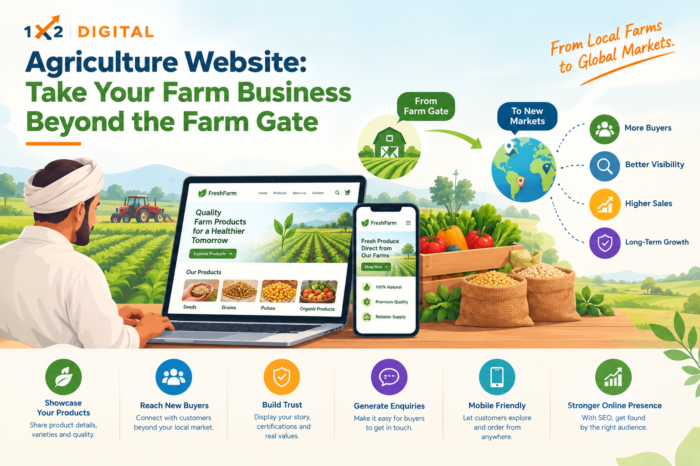
- Reach new buyers: Make products and services discoverable beyond the existing customer network.
- Present product information clearly: Share specifications, available varieties, packaging details, and other relevant information.
- Build buyer confidence: Introduce the business, explain its processes, and provide genuine company information.
- Generate enquiries: Allow potential customers to request quotations or discuss bulk orders.
- Support sales conversations: Give sales teams a useful page to share with prospective buyers.
The goal is not simply to have a website. It is to make it easier for the right customers to understand the business and take the next step.
What Makes an Agriculture Website Useful for Real Buyers?
A website can look attractive and still fail to generate enquiries. This often happens when businesses focus on appearance without considering what visitors need to know before making a purchasing decision.
A useful agriculture website should answer three basic questions: What do you offer? Why should a buyer trust you? How can the buyer contact you?
1. Present Products with Clear Information
Agricultural buyers often need more than a product name and a photograph. Depending on the business, they may want to understand product varieties, specifications, available quantities, packaging options, intended applications, and ordering requirements.
For example, an agricultural commodity supplier could organise its website into separate product pages for groundnuts, cumin seeds, pulses, and other available products. Each page could include relevant specifications, actual product photographs, packaging information, and an enquiry option.
This structure makes the buying process easier because visitors can find the information they need without contacting the business for every basic question.
2. Make Trust Easy to Establish
New customers may hesitate to contact an agricultural supplier when they cannot verify who operates the business or what it offers.
An agriculture website can reduce this uncertainty by including an accurate company profile, business contact details, genuine photographs, relevant certifications where applicable, and clear information about the products or services provided.
If the business serves wholesale buyers, it can also explain its order process, packaging capabilities, delivery arrangements, and quotation procedure, provided these details are accurate.
Avoid unsupported claims such as guaranteed quality or the largest supplier in a region. Specific, verifiable information is more useful for building long-term trust.
3. Make Enquiries Simple
Even interested buyers may leave a website if they cannot work out how to request a price or discuss an order.
A clear enquiry form should ask only for necessary information, such as the buyer’s name, contact details, product of interest, and approximate quantity. A WhatsApp contact option may also help customers who prefer direct conversations.
For businesses selling in bulk, a Request a Quote option can be more appropriate than displaying fixed prices for every product. The right approach depends on how the business sells and negotiates orders.
For example, if a seed supplier receives website visits but very few enquiries, it can review whether product specifications are clear, the contact form is easy to complete, and buyers can quickly find the information they need. Tracking enquiries alongside website visits can help the business identify what needs improvement.
Farm Website Design: Turning Information into Opportunities
A well-planned Farm Website Design should make the business easy to understand and the next action easy to complete. Visitors should not have to search through several pages to find products, contact information, or details about the farm.
Start with a clear homepage that explains what the business does and who it serves. Organise products into meaningful categories, use readable text, and include genuine images that represent the farm or business.
Mobile usability deserves particular attention. Buyers, distributors, and farmers may access the website from smartphones while travelling or working outside an office. Pages should load efficiently, buttons should be easy to tap, and enquiry forms should work properly on smaller screens.
Navigation also matters. A practical farm website might include:
- Home
- About the Farm or Company
- Products and Services
- Quality and Certifications
- Frequently Asked Questions
- Contact or Request a Quote
Not every agricultural business needs all these pages. A small farm selling directly to consumers may need a simple product catalogue, while an exporter serving wholesale buyers may require detailed product pages and business enquiry forms.
The best design is the one that supports the business model rather than adding unnecessary features.
Farm Web Design and SEO: Helping Buyers Find Your Business
Building a website does not automatically bring visitors. Agricultural businesses can use search engine optimization services to improve their website’s discoverability for relevant searches and attract more qualified visitors.
If potential customers cannot discover it through search engines, the website may receive fewer relevant enquiries than expected.
This is why Farm Web Design should be planned alongside search engine optimisation (SEO). Design helps visitors use the website, while SEO helps search engines understand its content and connect it with relevant searches.
Use Keywords That Match Buyer Intent
An agricultural business should consider the words customers actually use when searching for its products or services.
For example, a business selling farming equipment may need pages that describe the specific equipment it supplies. An organic farm could focus on the products it sells, the locations it serves, and the questions customers ask before purchasing.
When planning an agriculture website, start by understanding what potential customers are searching for. A seed supplier may need separate pages for seed varieties, while a farm equipment dealer may need detailed pages for the machinery it sells. If your business offers website development specifically for agricultural companies, terms such as Agriculture Website Design, Farm Website Design, and Agri Website may also be relevant to your service pages. The keywords you choose should match what your business offers and what your intended audience wants to find.
Use relevant phrases naturally in page titles, headings, descriptions, and useful body content. Avoid repeating keywords where they do not improve the reader’s understanding.
Create Helpful Pages Instead of One General Page
A single page listing every product may not answer specific buyer questions. Separate pages can help explain individual products, services, or categories in greater detail.
For example, a seed supplier might create dedicated pages for different seed varieties. A farm equipment dealer could provide separate pages for tractors, irrigation equipment, and other categories it actually sells.
Each page should offer original, useful information rather than repeating the same description with a different keyword.
Technical basics also matter: use descriptive page titles, clear headings, descriptive image alt text, sensible internal links, mobile-friendly layouts, and an XML sitemap. Businesses that need help with these technical requirements can explore technical SEO services.
Monitor indexing and organic search performance through tools such as Google Search Console.
These practices can improve discoverability, but search rankings depend on competition, content quality, technical health, relevance, and other factors. No website can guarantee a first-page position simply by including keywords.
From a Local Farm to a Wider Market
A well-developed website can help an agricultural business communicate with customers outside its immediate area. However, reaching new markets requires more than publishing product photographs online.
Businesses should explain which products they offer, which customers they serve, how enquiries are handled, and what buyers need to know before placing an order. Exporters may also need accurate information about packaging, documentation, shipping arrangements, and applicable compliance requirements.
For example, a commodity exporter can use product-specific landing pages to introduce its offerings to wholesale buyers. Businesses looking to improve their visibility in international markets can also explore SEO for import-export businesses.
Clear specifications and an enquiry form can help interested buyers start a conversation without relying entirely on referrals.
A business can also support its website through relevant social media content, email communication, and targeted digital advertising. These channels can bring potential visitors to the website, where clear information and a straightforward enquiry process can help turn interest into business opportunities.
The important point is to build a connected process: attract the right audience, provide useful information, and make it easy for interested buyers to get in touch.
Choosing the Right Digital Marketing Support for an Agriculture Website
Some agricultural businesses have the time and expertise to manage their website and marketing internally. Others may need professional support with website planning, SEO, content creation, or lead generation.
When evaluating an agency, look beyond promises of quick rankings. Ask how it will understand the target audience, organise the website, research relevant keywords, measure enquiries, and report on progress.
When choosing professional support, agricultural businesses should look for an agency that understands their goals, target audience, and market. Businesses in Gujarat can explore options such as a digital marketing agency in Rajkot or compare providers to find the best digital marketing agency in Ahmedabad. The right choice depends on the agency’s expertise, proposed strategy, and ability to measure meaningful results.
At 1into2 Digital, businesses can explore digital marketing services such as SEO, content marketing, and lead generation to support their online growth. The appropriate combination depends on the business’s target market, budget, and current online presence.
A website should be treated as an ongoing business asset. Reviewing visitor behaviour, enquiry quality, search performance, and customer feedback can reveal what needs improvement over time.
Conclusion: Take Your Agricultural Business Beyond the Farm Gate
Agricultural businesses do not have to rely exclusively on traditional networks to introduce their products to new customers. A well-planned Agriculture Website can help them present their offerings clearly, establish credibility, answer buyer questions, and generate enquiries beyond their existing market.
The key is to begin with the customer. Understand what buyers need to know, create useful product pages, make contact straightforward, and build visibility through relevant SEO practices. Then improve the website based on real visitor behaviour and business results.
The next big step after the farm gate is not simply going online. It is creating a digital presence that helps the right people discover the business, understand its value, and take action.
FAQs
1. How do I create a website for my farm?
To create a website for your farm, choose a suitable website platform, register a domain name, and select a simple design. Add details about your farm, products, services, and contact information. Use clear photos and make the website mobile-friendly. You can also use SEO to help potential customers find your farm online.
2. What is an agriculture website?
An agriculture website is an online platform where farmers and agricultural businesses can showcase their products, share farming information, and connect with potential customers. It helps them promote their business, reach more buyers, and generate enquiries online.
3. How can an agriculture website generate more enquiries?
An agriculture website can generate more enquiries by providing detailed product pages, clear business information, relevant search content, and easy-to-use contact forms. Businesses should also monitor website traffic and enquiry quality to understand which pages attract potential buyers.
4. How can I sell my farm products online?
You can sell your farm products online by creating a website, listing your products with clear photos and prices, and sharing your offerings on social media. You can also use online marketplaces to reach more customers. Provide clear product details and contact information to help buyers place orders easily.
5. Can farmers sell directly to customers?
Yes, farmers can sell directly to customers through their own websites, social media, local markets, and online marketplaces. Direct selling helps farmers reach more buyers, build customer relationships, and reduce their dependence on middlemen.
More from our blog
See all posts