Get Found, Get Clicks, Get Sales: The Power of Shopify SEO Services
- September 30, 2026
Introduction
Running a Shopify store is relatively easy. Getting the right people to discover that store through Google is much harder. You may have good products, attractive images, competitive prices, and a smooth checkout process, yet still receive fewer organic visitors than expected.
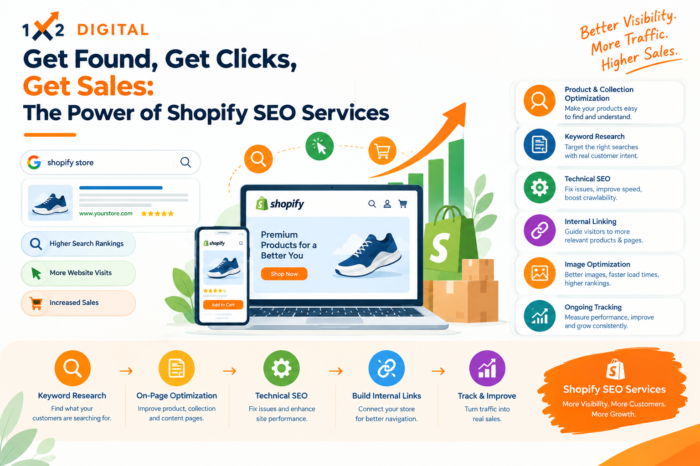
This is where Shopify SEO Services become important. Shopify SEO is not simply about adding keywords to product descriptions. It involves improving how search engines understand your store, how shoppers discover products, and how easily visitors move from a search result to a product page and finally to a purchase.
For a Shopify store, SEO needs to work across several connected areas: product pages, collection pages, site structure, content, technical setup, internal links, images, and user experience. When these areas support each other, organic search can become a more consistent source of relevant visitors instead of relying entirely on paid advertising.
Why Shopify Stores Often Struggle to Get Organic Traffic
A common problem for Shopify store owners is that having a technically functional website does not automatically mean that every important page will rank well.
For example, a store may have hundreds of products but very little useful content explaining what makes those products different. Product titles may be too short, descriptions may be copied from suppliers, collection pages may contain almost no supporting information, or important products may be difficult to reach through the site’s navigation.
Another issue is search intent. Someone searching for “buy running shoes for women” has a different purpose from someone searching for “how to choose running shoes.” If both searches are handled with the same type of page, the content may not properly answer what the shopper is looking for.
Good Shopify SEO Optimization starts by identifying these gaps rather than simply changing keywords everywhere.
How Shopify SEO Turns Search Visibility Into Store Visits
Ranking for a keyword is useful only when the resulting visitor has a reason to click and continue exploring the store.
A practical Shopify SEO strategy connects three things:
- Search demand: What potential customers are actually searching for.
- Relevant landing pages: Whether a product, collection, or informational page answers that search.
- Conversion path: Whether the visitor can easily understand the product, compare options, and take the next step.
For instance, a store selling skincare products may target a broad term on a collection page while using individual product pages for more specific searches. A supporting blog can answer questions about ingredients or product selection and then guide interested readers toward the relevant collection or product.
This structure helps prevent every page from competing for the same search terms.
What Shopify SEO Optimization Should Cover
Effective eCommerce SEO for a Shopify store should look at the entire customer journey rather than one isolated element.
Product Page Optimization
Product pages are often the most commercially important pages on an ecommerce website. Their titles, descriptions, headings, images, URLs, and supporting information should clearly communicate what the product is and who it is for.
A useful product description should answer questions a shopper may have before purchasing. Depending on the product, that could include size, material, features, compatibility, usage, care instructions, or other relevant details.
Simply repeating the product name several times does not make a page more useful. The better approach is to write naturally around the information customers actually need.
Collection Page Optimization
Collection pages can play an important role because shoppers often search for product categories rather than individual products.
A collection such as “Men’s Running Shoes” should provide enough context to help both users and search engines understand what belongs in that category. Relevant supporting copy, clear navigation, descriptive headings, useful filters, and links to related collections can make the page easier to use.
Collection pages should also avoid becoming thin pages containing only a product grid. The amount of supporting content should depend on the category and what shoppers need to make a decision.
Search-Friendly Titles and Meta Descriptions
Your title and meta description influence how your store appears in search results.
A useful title should make the page topic clear without becoming a long list of keywords. The meta description should give the searcher a reason to visit the page by accurately explaining what they can find there.
For example, instead of creating a title that repeats variations of “Shopify SEO” several times, a page can use a clear phrase such as Shopify SEO Services and then communicate the specific value of the page.
The goal is clarity first, not keyword repetition.
Internal Linking Between Important Pages
Internal links help shoppers move from one relevant page to another while also helping search engines understand the relationship between pages.
A blog about choosing running shoes could link to a relevant running-shoe collection. That collection could then link to specific product categories or products.
This creates a logical path:
Helpful content → relevant collection → product → purchase
Internal linking becomes especially important as a Shopify store grows. Without a clear structure, useful products can become buried several clicks away from important pages.
Image and Product Media Optimization
Ecommerce stores depend heavily on images, but large or poorly handled images can affect the shopping experience.
Product images should have descriptive file names and useful alt text where appropriate. Images should also be prepared in a way that supports reasonable page performance without sacrificing the visual information customers need.
Alt text should describe the image rather than being written as a place to insert keywords repeatedly.
Technical Shopify SEO
Technical SEO helps search engines discover, crawl, and understand the store.
Depending on the website, this can include reviewing:
- Indexable pages
- Canonical URLs
- Redirects
- Broken links
- Duplicate or low-value pages
- Site navigation
- Structured data
- Mobile usability
- Page performance
- Collection and product URL relationships
Shopify already handles some technical SEO elements automatically, so a good strategy should focus on genuine problems instead of charging for changes that the platform already manages.
This is an important point when comparing a Shopify SEO Agency or service provider: ask what technical work will actually be performed and why it is needed for your store.
Why Keyword Research Should Start With Customer Intent
Keywords are useful only when they represent real customer demand and match the page being optimized.
A Shopify store can have different keyword groups for different stages of the buying journey.
For example:
- Informational searches can be addressed through helpful guides.
- Category searches can lead to collection pages.
- Product-specific searches can lead to product pages.
- High-intent searches such as “buy” or “price” may require stronger commercial landing pages.
This prevents a common problem where one product page is expected to rank for every possible variation of a broad keyword.
Good keyword research also considers competition, relevance, search intent, and the actual products or services available on the website.
How Content Can Support Shopify Product Pages
A Shopify SEO strategy should not treat blogs as separate from content marketing for the store.
Helpful content can answer questions that product pages cannot reasonably cover in detail. For example, a furniture store could publish guides about choosing furniture for small rooms, maintaining different materials, or comparing product types.
The important part is what happens next.
If a reader finds a useful article but cannot easily reach the relevant products, the content has limited commercial value. Strategic internal links can connect informational searches with collection and product pages without making the article feel like an advertisement.
This approach allows content to support both organic visibility and product discovery.
Shopify SEO Agency vs Doing SEO Yourself
Not every Shopify store needs the same level of SEO support.
A small Shopify store with a limited number of products may be able to manage basic optimization internally. A growing store with hundreds or thousands of products can face a very different workload.
Doing SEO yourself gives you direct control and may make sense when someone on the team has the required time and knowledge. The trade-off is that SEO work competes with product management, customer service, advertising, and daily store operations.
A Shopify SEO Agency can provide dedicated strategy, technical analysis, content planning, optimization, and ongoing monitoring. The important question is not simply whether an agency offers many services. It is whether those services match the actual problems limiting your store.
Before hiring one, ask:
- Which Shopify pages will you optimize?
- How will you decide which keywords to target?
- Will you work on collection pages as well as products?
- How will technical issues be identified and fixed?
- How will internal linking be improved?
- What will be measured each month?
- How will organic traffic be connected with business outcomes?
Clear answers make it easier to compare agencies based on actual work rather than promises.
How to Measure Whether Shopify SEO Is Working
SEO should be measured beyond keyword rankings with eCommerce Analytics that connects traffic and customer behaviour with business performance.
Useful performance indicators can include:
- Organic clicks
- Organic impressions
- Search queries
- Organic sessions
- Product and collection page traffic
- Click-through rate
- Conversions from organic traffic
- Organic revenue
- Indexed pages
- Performance of important landing pages
These metrics help answer a more useful question: Is organic search bringing the right visitors to pages that can actually support the business through Conversion Rate Optimization?
For example, traffic increasing while relevant product pages receive little engagement may indicate that the store is attracting searches that do not match its products. In that situation, simply chasing more traffic may not solve the underlying problem.
Common Shopify SEO Mistakes That Can Limit Growth
Several issues appear repeatedly in ecommerce SEO projects.
Using supplier descriptions without improving them:
If many stores use the same manufacturer description, your product page has little unique information to offer.
Ignoring collection pages:
Focusing entirely on individual products can leave valuable category-level searches poorly targeted.
Creating too many low-value pages:
Filters, tags, parameters, and duplicate paths can create pages that add little value while making the site’s structure harder to manage.
Overusing keywords:
Repeatedly inserting the same phrase can make product descriptions difficult to read and does not replace useful information.
Ignoring internal links:
A strong product page can still struggle if users and search engines have difficulty reaching it from important areas of the store.
Measuring only rankings:
A ranking change does not automatically mean more qualified traffic or sales. Organic clicks, engagement, conversions, and revenue provide a more complete picture.
How to Choose Shopify SEO Services for Your Store
The right Shopify SEO Company should be able to explain its process in terms of your store rather than giving you a generic ecommerce checklist.
Look for a clear connection between keyword research, technical SEO, product optimization, collection strategy, content, internal linking, and measurement.
It is also worth checking whether the provider understands the limitations and structure of Shopify itself. Shopify has its own platform features and URL patterns, so a strategy copied directly from another CMS may not be appropriate.
If you are comparing providers, request a sample audit or an explanation of what they would investigate first. You should be able to understand what problems they have identified, what changes they recommend, and how those changes could affect search visibility and product discovery.
For businesses looking for broader online growth, a digital marketing agency in Rajkot may also combine Shopify SEO with content marketing, paid campaigns, social media, and conversion-focused improvements. Similarly, businesses operating around Gujarat’s major commercial markets may search for a best digital marketing agency in Ahmedabad that can coordinate SEO with other digital channels. The important consideration is whether the services are connected to your actual business goals rather than simply bundled together.
Shopify SEO Is an Ongoing Process
A Shopify store changes constantly. New products are added, old products go out of stock, collections change, competitors publish new content, and customer search behaviour evolves.
That means SEO should not be treated as a one-time task where titles and descriptions are updated once and forgotten.
A practical process is to identify the pages with the greatest opportunity, improve them, monitor their performance, and then use the data to decide what should be addressed next.
The objective is not to make every page look optimized on paper. It is to make the store easier to discover, easier to understand, easier to navigate, and more useful for people who are genuinely looking for what you sell.
When Shopify SEO Services are built around those goals, organic search becomes more than a traffic channel. It becomes a way to connect relevant shoppers with the right products at the right stage of their buying journey.
FAQS
1. Can you do SEO on Shopify?
Yes, you can do SEO on Shopify. You can optimize product and collection pages, improve titles and meta descriptions, use relevant keywords, optimize images, and strengthen internal links. Basic SEO can be managed in-house, while larger stores may benefit from professional Shopify SEO services for technical optimization, content planning, and ongoing performance tracking.
2. How to optimize SEO for Shopify?
To optimize SEO for Shopify, start by researching relevant keywords and assigning them to the right product, collection, or content pages. Improve page titles, meta descriptions, product content, headings, and image alt text while keeping the language natural. You should also review internal links, site structure, redirects, duplicate pages, and page performance. Regularly tracking organic traffic, clicks, and conversions can then show which pages need further optimization.
3. Does Shopify have SEO built in?
Yes, Shopify has several SEO features built in, including editable page titles and meta descriptions, automatic sitemaps, canonical tags, and options for managing image alt text. However, built-in features provide a foundation rather than a complete SEO strategy. Improving keyword targeting, product and collection pages, internal linking, content, and technical performance still requires ongoing optimization.
4. What should Shopify SEO services include?
Shopify SEO services should cover more than keywords and meta tags. A practical service should include keyword research, product and collection page optimization, internal linking, image optimization, technical SEO checks, content improvements, and performance tracking. It should also review issues such as duplicate pages, redirects, site structure, and indexing. The exact work depends on the store’s size, product catalog, competition, and existing SEO performance.
5. How do I choose a Shopify SEO agency
When choosing a Shopify SEO agency, look for experience with Shopify-specific SEO rather than only general ecommerce SEO. Ask what they will optimize, including product pages, collection pages, internal links, technical issues, and content. It is also useful to ask how they measure progress and whether they can show relevant Shopify case studies or explain their process clearly. Most importantly, choose an agency whose approach matches your store size, product catalog, competition, and business goals.
More from our blog
See all posts