The Recipe for Attention: How Food Advertising Turns Viewers Into Customers
- September 28, 2026
Introduction
A food advertisement has only a few seconds to make someone stop scrolling, notice the product, and think, “I want that.”
But getting attention is only the beginning.
For restaurants, food brands, cafés, cloud kitchens, and packaged food businesses, the real challenge is turning that attention into something valuable—website visits, enquiries, orders, store visits, or repeat customers.
That is why effective Food Advertising is not simply about making food look delicious. It is about understanding what customers want, presenting the product in the right way, choosing the right platform, and making the next step easy.
Why Food Advertising Is More Than a Good-Looking Picture
Food is naturally visual, which makes advertising an important part of how customers discover and evaluate food businesses.
A strong image can create appetite. A short video can show preparation. A customer review can build trust. A limited-time offer can create urgency.
But these elements need to work together.
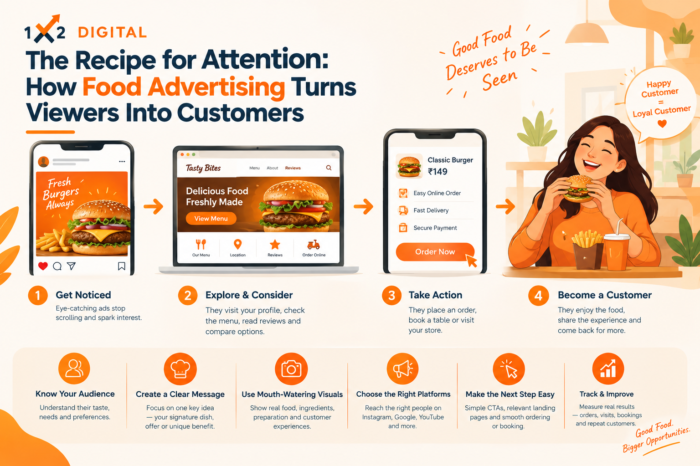
Consider a customer looking for a burger online. They may:
- See a food ad on Instagram.
- Visit the restaurant profile.
- Check the menu and prices.
- Look at reviews or customer photos.
- Compare it with other options.
- Place an order or visit the restaurant.
If the advertisement attracts attention but the next steps are confusing, the business can lose the customer.
Good advertising should therefore solve the customer’s next question, not just capture their attention.
Start With the Customer, Not the Advertisement
One common mistake in Food Advertising is starting with the creative idea before understanding the audience.
A restaurant targeting college students may focus on affordability, quick delivery, or shareable meals. A premium restaurant may need to communicate ambience, presentation, ingredients, and experience.
A packaged food brand may have a completely different objective: product awareness, retail demand, or online purchases.
Before creating an advertisement, ask:
- Who is the customer?
- What problem or desire does the product address?
- Why would they choose this food over alternatives?
- What information do they need before buying?
- What action should they take after seeing the ad?
These questions make the advertising strategy more focused and help businesses create messages that are relevant to the people they actually want to reach.
Make Food Ads About One Clear Idea
The strongest Food Ads do not try to communicate everything at once.
An advertisement may focus on:
- A signature dish
- A new product
- A special offer
- Fast delivery
- A unique ingredient
- A seasonal menu
- A dining experience
- A customer problem
For example, instead of an advertisement saying:
“We have burgers, pizzas, sandwiches, shakes, desserts and special offers.”
a campaign could focus entirely on one signature burger and give customers one clear reason to try it.
The simpler the message, the easier it is for people to understand, remember, and act on.
Use Visuals That Create Appetite
Food is one of the few categories where the visual itself can strongly influence interest.
That makes photography, video, colours, composition, packaging, and presentation important parts of Food Product Advertising.
Instead of relying only on generic stock photographs, businesses can show:
- Freshly prepared dishes
- Close-up food shots
- Ingredients
- Cooking processes
- Product packaging
- Real customer experiences
- Behind-the-scenes preparation
Short-form videos can also show details that a static image cannot—cheese melting, a dish being plated, a drink being poured, or a product being opened.
The objective is not simply to make the food look attractive. The visual should help customers understand what they are getting and why it is worth trying.
Choose the Right Platform for the Buying Journey
Not every food advertisement belongs on the same platform.
The right channel depends on what the customer is looking for and how close they are to making a decision.
Instagram and Facebook
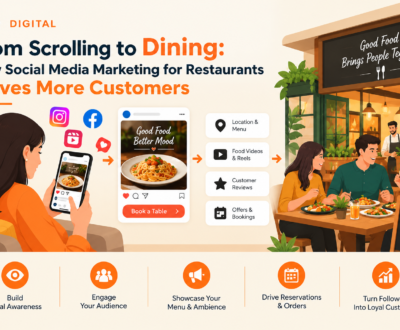
Instagram and Facebook can help food businesses create awareness through Reels, Stories, product visuals, customer content, and promotional campaigns. Businesses looking for a more detailed restaurant-focused approach can explore social media marketing for restaurants.
They can be useful when the objective is to introduce a food product, showcase a restaurant experience, promote an offer, or encourage customers to explore the brand.
SEO can help food businesses become more visible when customers are already searching for something specific, such as a restaurant, food product, delivery option, or nearby dining experience. For businesses that want to reach high-intent searches through paid placements, a clear Google Ads campaign strategy can help align targeting, messaging, and measurement with that intent.
YouTube
Video can be useful when the product needs demonstration or storytelling.
A food brand can use short videos to explain ingredients, preparation, recipes, product features, or customer experiences.
The important point is to match the platform with the customer’s stage rather than simply publishing the same advertisement everywhere.
Advertising in Restaurants Should Continue Beyond the Screen
Advertising in Restaurants does not have to stop at digital campaigns.
The physical customer experience can become part of the marketing itself.
Menus, table cards, packaging, takeaway bags, restaurant signage, QR codes, and loyalty offers can all encourage another action.
For example, a takeaway package could include a QR code leading to:
- A review page
- A loyalty programme
- A new menu
- A special offer
- The restaurant’s social profile
This creates a connection between the customer’s offline experience and the brand’s digital presence.
A customer who has already visited the restaurant is no longer just a prospect. With the right follow-up, that experience can become an opportunity for another order, review, recommendation, or visit.
Fast Food Advertising Needs Speed and Clarity
Fast Food Advertising works in an environment where customers often make decisions quickly.
The message should therefore communicate the important information almost immediately.
A useful fast-food advertisement might highlight:
Product + benefit + offer + action
For example:
New Loaded Burger | Ready for Your Next Craving | Order Today
The exact message will depend on the business, but the principle remains the same: do not make customers work to understand the advertisement.
Strong food advertising often gives people enough information to understand the offer without overwhelming them with unnecessary copy.
Make Food Ad Posters Work Harder
A Food Ad Poster may appear simple, but poor design can make even a good product difficult to notice.
A useful poster should have a clear visual hierarchy.
The customer should be able to identify:
- What is being promoted?
- Why should I care?
- Is there an offer or important detail?
- What should I do next?
Too much text, too many competing images, or several different offers can weaken the main message.
A strong poster often does more with less. The product should remain the visual focus, while the supporting information should guide the customer towards the intended action.
Turn Attention Into Action
Getting someone to notice a food advertisement through social media marketing is not the final objective.
The next step should be obvious.
Depending on the business, the call to action could be:
- Order Now
- View Menu
- Book a Table
- Try the New Product
- Get Directions
- Shop Now
- Contact Us
The CTA should match what the customer can realistically do after seeing the advertisement.
If the advertisement promotes a new restaurant dish, asking the customer to “Learn More” may be less direct than giving them a clear option to view the menu or order.
A clear CTA reduces uncertainty and helps move the customer from interest to action.
Don’t Ignore the Landing Experience
Imagine a customer clicks an advertisement promoting a special meal, but the website opens on a general homepage where the customer has to search for the advertised product.
That extra effort can reduce the chance of conversion.
The destination after the advertisement should continue the same message.
If the ad promotes a particular product, the landing page should make that product easy to find.
If the ad promotes a restaurant offer, the customer should quickly see the offer, relevant details, location, and booking or ordering option.
The advertisement creates the expectation. The landing experience needs to fulfil it.
This connection between the advertisement and the destination page is especially important when businesses are paying for every click.
Measure More Than Likes and Views
A food advertisement can receive thousands of views without generating meaningful business results.
That is why businesses should connect advertising performance with actual customer actions.
Useful metrics can include:
- Click-through rate
- Website visits
- Menu views
- Calls
- Directions requests
- Online orders
- Bookings
- Cost per enquiry
- Conversion rate
- Repeat purchases
For example, an advertisement with fewer views but more orders may be more useful to a restaurant than a highly viewed advertisement that generates no measurable action.
The goal is not simply to make an advertisement popular.
The goal is to make the advertising useful for the business.
How Food Brands Can Make Advertising More Memorable
Memorable advertising does not always require a huge budget.
A food business can build recognition by developing a consistent creative style supported by strong branding.
That could include:
- A recognizable visual identity
- A recurring content format
- A distinctive brand voice
- Consistent product presentation
- Seasonal campaigns
- Customer-generated content
- Local cultural references
The important part is consistency.
When customers repeatedly see a recognizable style connected with the same food brand, the advertising becomes easier to remember and the brand can become more familiar over time.
Solve the Real Problem Behind Poor Food Advertising
If a food business is spending money on advertisements but results remain weak, increasing the budget may not solve the underlying problem.
The issue could be related to conversion rate optimization , along with problems such as:
- The wrong audience
- Weak messaging
- Poor-quality visuals
- An unclear offer
- An ineffective landing page
- Complicated ordering
- Weak follow-up
- Poor campaign tracking
This is why advertising should be treated as a complete customer journey rather than a single creative post.
Before spending more, businesses should identify where customers are losing interest or failing to take the next step.
Sometimes the biggest improvement does not come from creating more advertisements. It comes from fixing the part of the journey that is preventing interested customers from converting.
How 1into2 Digital Approaches Food Advertising
For a food business, advertising is most useful when the creative idea, audience, offer, and conversion path support the same objective.
At 1into2 Digital, the focus can be on connecting these elements rather than treating an advertisement as an isolated campaign.
For example, a food business launching a new product may need to identify the right audience, develop clear advertising messages, create suitable visuals, direct users to a relevant landing page, and measure the actions generated by the campaign.
The same approach can apply to restaurants promoting new menus, special offers, online ordering, or local campaigns.
The goal is to understand what happens after the advertisement gets attention—whether people visit the website, view the menu, make an enquiry, place an order, visit the location, or take another meaningful action.
For businesses looking for a digital marketing agency in Rajkot or a best digital marketing agency in Ahmedabad,effective food advertising should go beyond creating attractive ads. The real value comes from connecting the right audience, creative message, customer experience, and measurable business goals.
Turn Food Advertising Into Measurable Customer Action
A food advertisement should do more than attract attention. It should give people a clear reason to visit, order, enquire, or try the product.
The process can be viewed simply:
Audience → Message → Creative → Platform → Landing Experience → Action → Measurement
When one part of this journey is weak, the advertisement may struggle to produce meaningful results even if the creative itself looks attractive.
For food businesses, this means reviewing the complete path rather than judging a campaign only by impressions, likes, or views.
A focused advertising strategy can help businesses understand which messages attract the right audience and which campaigns contribute to measurable customer activity.
Conclusion
Effective Food Advertising is not simply about making people hungry.
It is about understanding the customer, presenting the right message, choosing the right platform, and making the path to purchase simple.
From Food Ads and Fast Food Advertising to Food Ad Posters and Food Product Advertising, every campaign should have a clear purpose.
When creative ideas, targeting, customer experience, and conversion strategy work together, advertising can move beyond attention and contribute to real business growth.
The strongest food advertising connects three things: what the customer wants, what the business offers, and what the customer should do next.
That is how a few seconds of attention can become a meaningful customer action.
FAQs
1. What is Food Advertising?
Food Advertising is the promotion of food products, restaurants, cafés, delivery services, and food brands through channels such as search engines, social media, websites, video, print, and outdoor media.
2. What makes Food Ads effective?
Effective Food Ads usually have a clear audience, one strong message, appealing visuals, a relevant offer, and an easy next step for the customer.
3. How does Fast Food Advertising work?
Fast Food Advertising generally focuses on quick decision-making. Clear product visuals, concise messaging, offers, convenience, and direct calls to action can help customers understand the proposition quickly.
4. What should a Food Ad Poster include?
A Food Ad Poster should clearly communicate the product or offer, use a strong visual, keep the text easy to read, and provide a clear action such as ordering, visiting, booking, or learning more.
5. How can Food Product Advertising increase sales?
Food Product Advertising can help increase awareness and consideration by showing the product clearly, communicating its relevant benefits, reaching the right audience, and directing interested customers toward an easy purchase path.
More from our blog
See all posts