From Searches to Solar Sales: How Smarter Solar Advertising Generates Qualified Leads
- September 25, 2026
Introduction
For a solar business, getting people to see an advertisement is easy. Getting the right people to enquire, trust the business, and eventually become customers is much harder.
Many solar companies spend money on advertising but still receive enquiries from people who are only checking prices, asking for unrealistic discounts, or are not ready to install solar. In such cases, the problem is not always a lack of leads. It may be that the advertising strategy is attracting the wrong audience or failing to guide interested prospects toward the next step.
This is where smarter Solar Advertising can make a difference. Instead of focusing only on clicks and enquiry numbers, businesses need to understand customer intent, address real concerns, and create a clear path from the first search to the final enquiry.
Why Solar Advertising Needs a Different Approach
Solar is not an impulse purchase. A homeowner or business owner may compare system sizes, installation costs, expected savings, warranties, financing options, and different installers before making a decision.
This means an advertisement should do more than say, “Buy solar today.” It should give the potential customer a useful reason to continue the conversation.
Before contacting a solar company, customers may ask:
- How much can solar reduce my electricity bill?
- What system size is suitable for my property?
- What will the installation cost?
- Am I eligible for a subsidy?
- How long could it take to recover the investment?
- What warranty and after-sales support are available?
- Can I trust the installer?
When advertising addresses these questions clearly, customers can make decisions with greater confidence and businesses can attract more relevant enquiries.
Build Solar Ads Around Customer Intent
Not every person searching for solar is at the same stage of the buying journey.
Someone searching for “solar panel price” may still be researching. Someone searching for “solar installation company near me” may already be comparing providers.
Treating both users in exactly the same way can result in wasted advertising spend, which is why a data-driven Google Ads strategy can help businesses align campaigns with search behaviour. A better approach is to match the message with the customer’s intent.
For Customers Still Researching
Informational content can help users understand:
- Solar system costs
- System sizing
- Electricity savings
- Installation requirements
- Subsidy-related information
- Maintenance and warranty considerations
At this stage, the objective is to answer questions and build familiarity rather than push for an immediate sale.
For Customers Ready to Take Action
Customers closer to making a decision may respond better to:
- Solar installation services
- Free site assessments
- Project experience
- Customer reviews
- Warranty information
- Clear quotation or consultation options
This simple separation helps businesses spend their advertising budget on the right message for the right audience.
Make Solar Power Ads Focus on a Real Customer Benefit
Effective Solar Power Ads should communicate a specific benefit instead of relying on broad promotional claims.
For example, rather than:
“Get the Best Solar System Today”
a more useful message could be:
“Find the Right Rooftop Solar System for Your Electricity Usage”
The second message connects the advertisement with a customer need. It gives people a reason to learn more instead of simply asking them to buy.
The visual side of advertising matters as well. Solar Panel Ads can become more credible when they show genuine installations, rooftops, system components, or real project experiences instead of relying entirely on generic stock images.
Real photographs and short installation videos can help potential customers understand what the business actually does before they even visit the website.
Make Google Ads for Solar Companies More Intent-Focused
Google Ads for Solar Companies can help businesses reach users who are already searching for solar products and services. However, simply bidding on broad keywords does not guarantee qualified leads.
A more focused campaign can organize keywords around:
- Residential and commercial requirements
- Location
- Installation services
- System size
- Pricing searches
- High-intent service queries
Negative keywords are also important. They can help reduce irrelevant clicks from searches that are unlikely to result in a genuine business enquiry.
The advertisement should then match the landing page.
For example, if someone clicks an ad for rooftop solar installation, sending them to a general homepage forces them to search for the information they were already looking for. A dedicated page can instead explain the service, show relevant projects, answer common questions, and provide a clear way to enquire.
Don’t Stop at the Click: Fix the Landing Page
A good advertisement cannot solve every problem if the landing page optimization strategy creates confusion.
After clicking a Solar Ad, a potential customer should quickly understand:
- What the company offers
- Whether the service is available in their location
- Why the company can be trusted
- What the customer can expect
- What action they should take next
A useful landing page can include:
- Real project photographs
- Customer testimonials
- Certifications or relevant credentials
- Service locations
- Frequently asked questions
- Clear service information
- A simple enquiry form
- Click-to-call or WhatsApp options
The call to action should also be specific to the customer’s needs. Options such as “Get a Solar Quote,” “Book a Site Assessment,” or “Talk to a Solar Expert” can make the next step clearer than a generic “Submit” button.
Turn More Leads Into Qualified Enquiries
A common advertising mistake is measuring success only by the number of leads generated.
Consider two campaigns:
- Campaign A generates 200 enquiries, but most people are only looking for the cheapest price.
- Campaign B generates 70 enquiries, with a larger share genuinely interested in installation.
The second campaign may create more meaningful sales opportunities even though it produces fewer enquiries.
That is why solar businesses should track metrics beyond clicks and form submissions, while also using conversion rate optimization to understand how effectively those visits become enquiries.
- Qualified leads
- Cost per qualified lead
- Enquiry-to-appointment rate
- Appointment-to-sale rate
- Conversion rate
- Lead source
This helps identify which campaigns are bringing actual business opportunities rather than simply generating activity.
Use Different Channels for Different Stages
A potential customer may not be ready to enquire after seeing one advertisement.
Different channels can support different parts of the customer journey:
Google Search: Reach people actively looking for solar products or installation services.
Social Media: Build awareness and explain solar benefits through educational content.
YouTube: Use videos to explain complex topics such as system sizing, installation, and savings.
Retargeting: Reconnect with people who visited the website or interacted with an advertisement but did not enquire.
The objective is not to be everywhere without a purpose. It is to use each channel where it can contribute to the customer’s decision-making process.
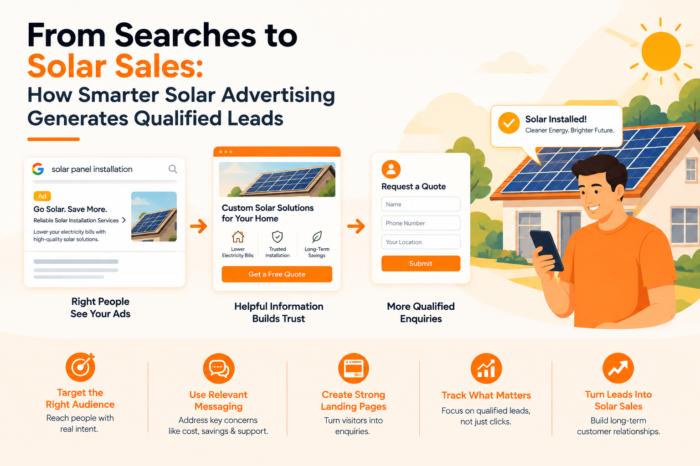
What Makes Solar Advertising More Effective?
A strong solar advertising campaign usually depends on four connected elements:
Relevant targeting: Reach people who have a genuine need for the product or service.
Useful messaging: Address concerns around cost, savings, installation, reliability, and support.
Strong landing pages: Give visitors the information they need without making them search for it.
Proper tracking: Measure qualified enquiries and sales, not just impressions and clicks.
If any one of these areas is weak, the overall campaign can suffer. For example, excellent ads may still produce poor results if the landing page is unclear. Similarly, a good landing page cannot compensate for irrelevant traffic.
This is why solar advertising should be treated as a complete customer journey rather than a single advertisement.
Turn Solar Advertising Into Better Business Opportunities
Getting clicks from Solar Ads is only the beginning. The real opportunity is turning those clicks into enquiries from people who are genuinely interested in installing solar.
That requires more than attractive creatives. Audience targeting, keyword selection, ad messaging, landing pages, conversion tracking, and follow-up all influence whether an advertising campaign produces useful business opportunities.
At 1into2 Digital, we look at this complete journey when building digital marketing strategies for businesses. For solar companies, that can mean identifying the right audience, developing intent-focused campaigns, improving landing-page journeys, and creating clearer paths from search to enquiry.
If your current campaigns are generating traffic but not enough qualified leads, increasing the advertising budget may not be the first solution. The better starting point is to identify where potential customers are dropping out and what can be improved at each stage.
Whether a business is looking for a digital marketing agency in Rajkot or exploring digital marketing support from the best digital marketing agency in Ahmedabad, the focus should remain the same: building a strategy around business goals, customer intent, and measurable results.
If your solar campaigns are getting clicks but not enough meaningful enquiries, 1into2 Digital can help you identify the gaps and build a more focused path from advertising to qualified leads.
Conclusion
Effective Solar Advertising is not about showing more advertisements to more people. It is about reaching the right audience with a message that answers their questions and makes the next step clear.
From Solar Ads and Solar Power Ads to Solar Power Advertisement, Solar Panel Ads, and Google Ads for Solar Companies, every campaign should connect targeting, messaging, landing pages, and follow-up.
The real objective is not simply to generate more leads. It is to generate enquiries with genuine business potential.
When solar advertising is built around customer intent and supported by a strong conversion strategy, online searches can become meaningful conversations—and meaningful conversations can become customers.
FAQs
1. What are Solar Ads?
Solar Ads are advertisements used to promote solar products, installation services, and energy solutions through platforms such as Google, Facebook, Instagram, and YouTube.
2. How can Solar Ads generate better-quality leads?
Better targeting, intent-based keywords, clear messaging, relevant landing pages, and proper lead tracking can help reduce irrelevant enquiries and improve lead quality.
3. What makes effective Solar Power Ads?
Effective Solar Power Ads focus on genuine customer needs such as electricity savings, installation, system selection, financing, or solar consultations instead of relying on vague promotional claims.
4. How do Google Ads for Solar Companies work?
Google Ads can help solar businesses appear when users search for relevant products or services. Results depend on factors such as keyword selection, targeting, ad messaging, landing pages, and ongoing campaign optimization.
5. Why are landing pages important for Solar Panel Ads?
A relevant landing page continues the message started by the advertisement. It can explain the service, provide proof, answer common questions, and make it easier for an interested visitor to enquire.
More from our blog
See all posts