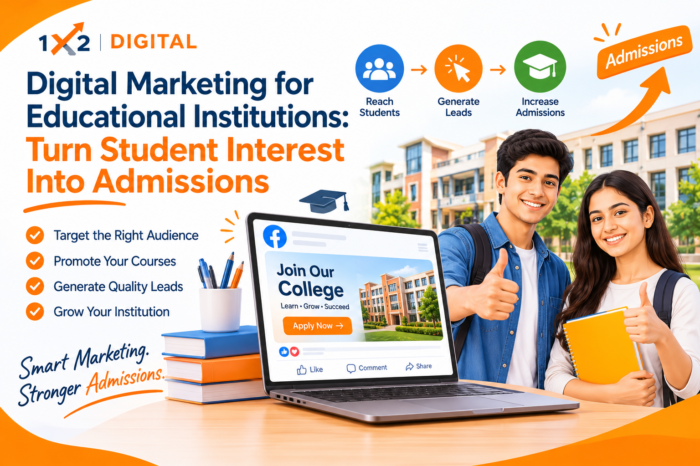
Digital Marketing for Educational Institutions: Turn Student Interest Into Admissions
- September 17, 2026
Introduction
Choosing a school, college, or coaching institute is an important decision for students and their families. Before making that choice, many people explore course options, compare institutions, check facilities, read reviews, and look for clear information about fees and admissions.
Most of this research can happen online before a student ever visits a campus.
For educational institutions, this creates an important challenge: being visible online is only the first step. The real opportunity is helping interested students find the right information and move confidently towards admission.
A school may have excellent teaching facilities but struggle to reach parents in its service area. A college may offer valuable programmes but receive enquiries from students who do not meet its eligibility requirements. A coaching institute may attract website visitors without generating enough counselling appointments.
These problems require more than occasional advertisements or regular social media posts.
A well-planned Digital Marketing for Educational Institutions strategy connects an institution’s courses, online communication, enquiry process, and admission goals. It helps the right audience discover relevant programmes and understand what to do next.
This guide explains how educational institutions can identify gaps in their online presence, attract suitable students, improve enquiries, and build a more effective digital admission journey.
1. Start With the Admission Problem, Not the Marketing Channel
Before choosing digital marketing services, identify where prospective students are losing interest.
Different institutions face different challenges. A school may need more parent enquiries, while a university may want to increase applications for a particular degree. A coaching centre may need more qualified counselling bookings before a new batch begins.
Using the same marketing plan for every situation can waste time and money.
Identify Where Prospective Students Drop Off
Review the complete journey from discovering your institution to submitting an application.
- Low online visibility: Students searching for relevant courses do not discover your institution.
- Limited website engagement: Visitors arrive but leave without exploring programme details.
- Unclear admission information: Students cannot easily understand eligibility, fees, deadlines, or application steps.
- Irrelevant enquiries: Marketing attracts people whose interests or qualifications do not match the programme.
- Weak follow-up: Interested students do not receive the information or guidance they need.
- Incomplete applications: Students begin the admission process but do not finish it.
Each problem needs a different response.
For instance, if a college receives enquiries but few eligible applicants, broadening its advertising audience may make the problem worse. Improving eligibility information and refining campaign targeting could be more useful.
Set One Clear Objective for Each Campaign
Give every marketing activity a specific purpose.
A school might aim to increase campus visit bookings. A university could focus on applications for a new postgraduate programme. A coaching institute might measure how many suitable students book a counselling session.
Clear objectives help institutions select appropriate channels and evaluate results against meaningful outcomes rather than simply counting clicks or followers.
2. Build a Website That Helps Students Make Informed Decisions
Your website should work like a reliable information centre for prospective students and parents.
When visitors arrive, they should quickly understand what the institution offers, whom its programmes are suitable for, and how to enquire or apply.
A visually attractive website is helpful, but design alone cannot answer the questions that influence admission decisions.
Give Every Important Programme a Clear Information Page
Create dedicated pages for major courses, departments, or academic programmes where appropriate.
Each page should explain:
- Programme structure, subjects, and duration.
- Eligibility requirements and admission criteria.
- Current fee information or instructions for obtaining it.
- Application procedures and relevant deadlines.
- Available facilities, practical learning opportunities, and academic support.
- Career pathways or further study options, described accurately.
- Contact details for programme-specific questions.
Avoid making students search through multiple unrelated pages to understand a single course.
For example, a student considering a computer science degree should be able to find its curriculum, admission requirements, available learning facilities, and application process without repeatedly returning to the homepage.
Make the Next Step Obvious
Every important programme page should provide a relevant next action.
Depending on the institution, this could be:
- Request course information.
- Book a counselling appointment.
- Arrange a campus visit.
- Download an admission brochure.
- Start an application.
Keep forms simple and explain what happens after submission. If an admissions representative will contact the student, say so clearly and provide an appropriate timeframe where the institution can reliably meet it.
A clear process reduces uncertainty and helps interested visitors take action.
Check the Mobile Experience
Students and parents may access admission information from different devices, including mobile phones with slower connections.
Test whether visitors can read course details comfortably, open forms, tap contact links, and complete enquiries without unnecessary effort.
Check loading performance, navigation, form errors, and accessibility. Remove elements that distract visitors from finding information or completing the intended action.
3. Help Students Discover Your Institution Through Search
Students often begin their research with a question rather than an institution’s name.
They might search for a degree programme, a school admission process, a course after Class 12, or a coaching centre offering preparation for a specific examination.
Your website needs useful pages that address these searches.
Create Content Around Real Student Questions
Speak with admissions staff to identify the questions they answer repeatedly. These conversations can reveal valuable topics for course pages, articles, and frequently asked questions.
Examples include:
- What are the eligibility requirements for this programme?
- Which subjects will students study?
- What documents are required for admission?
- How does the application process work?
- What facilities are available for practical learning?
- What should students consider before selecting this course?
Answer these questions accurately and in sufficient detail.
Avoid publishing several nearly identical pages simply by changing the course name or city. Each page should provide information that is genuinely relevant to its intended audience.
Improve Search Engine Accessibility
Search engine optimization involves helping search engines discover, understand, and evaluate the pages on your website.
Review whether important pages can be crawled and indexed. Check canonical tags, internal links, redirects, XML sitemaps, and mobile usability. Institutions that need professional support can explore relevant SEO services to improve their search visibility and technical website health. Make sure the page you want Google to index is the page your website identifies as its preferred version.
Google Search Console can help identify indexing issues and show which search queries generate impressions and clicks.
If a newly published article is not indexed, inspect its URL in Search Console before assuming that the writing itself is the problem. Review the reported indexing status, Google-selected canonical, crawl information, and any technical issues that need attention.
Remember: publishing a new article does not guarantee indexing. The page must also be accessible and suitable for inclusion in Google’s search results.
4. Use Educational Content to Build Confidence Before Admission
Students and parents need more than promotional statements to evaluate an institution.
They want to understand the learning environment, teaching approach, available facilities, academic expectations, and support offered throughout their studies.
Educational content can answer these questions before a student contacts the admissions office. Institutions that need support planning and creating useful material can explore relevant content marketing services.
Show What Students Can Actually Experience
Instead of repeatedly publishing generic promotional messages, develop content that demonstrates the institution’s real strengths.
Consider creating:
- Short explanations of subjects and learning activities.
- Faculty introductions that highlight genuine academic expertise.
- Demonstrations of laboratories, workshops, libraries, or other facilities.
- Student project presentations published with appropriate permission.
- Explanations of scholarships, academic support, and student services.
- Campus visit guides and admission process walkthroughs.
- Genuine student experiences that have been approved for publication.
The purpose is not to make every institution appear perfect. It is to give prospective students enough reliable information to decide whether the institution meets their needs.
Address Parent Concerns as Well as Student Interests
Students and parents may evaluate the same institution differently.
Students may prioritise subjects, campus activities, learning opportunities, and future options. Parents may want clearer information about fees, safety arrangements, facilities, communication, and academic support.
Plan content for both audiences where appropriate.
A school, for example, could explain its teaching methods and parent communication process. A college could provide detailed programme information alongside practical guidance for families comparing educational options.
Accurate, consistent communication can help establish trust before the first admission enquiry.
5. Turn Social Media Into a Useful Communication Channel
Social media can help institutions introduce their programmes, demonstrate campus life, answer common questions, and maintain communication with interested students.
However, posting frequently does not automatically produce meaningful admission enquiries.
The value of social media depends on whether the content is relevant to the people the institution wants to reach.
Develop Content for Different Admission Stages
Organise content around what prospective students need to know.
Discovery content: Introduce courses, teaching facilities, extracurricular activities, and the institution’s educational approach.
Consideration content: Explain programme differences, eligibility, learning opportunities, fees, and frequently asked questions.
Action-oriented content: Share verified admission dates, campus visit information, counselling options, and application instructions.
This approach gives students useful information throughout their decision-making process.
Make Short Videos Informative
Short videos can demonstrate an aspect of campus life or explain a specific question in a convenient format.
A faculty member could explain an important course concept. An admissions representative could walk through the documents required for an application. A campus video could show the actual facilities available to students.
Use clear captions, readable text, and an appropriate call to action.
Publish genuine information and obtain consent before sharing identifiable student experiences. Avoid unsupported claims about placements, results, rankings, or guaranteed career outcomes.
6. Use Paid Advertising to Reach Relevant Prospective Students
Organic search and social media can support long-term visibility, but some institutions also need targeted campaigns for admission deadlines, new programmes, or upcoming batches.
Paid advertising can help reach relevant audiences when the campaign has a clear purpose and a suitable destination page.
Match Every Advertisement to a Specific Programme
Start by identifying the programme, intended audience, geographic service area, and action you want visitors to take.
For example, an advertisement for a postgraduate management course should lead to a page containing the course’s eligibility criteria, duration, current fees or fee information, and application details.
An advertisement for a school open day should make the date, location, registration process, and visit arrangements easy to find.
Avoid sending every advertisement to the same generic homepage when a more relevant page is available. Institutions planning targeted paid promotion can explore Google Ads campaigns to understand the available advertising approach.
Evaluate Campaign Quality Before Increasing Spend
Monitor more than impressions and clicks.
Review whether enquiries are relevant, whether prospective students meet the stated criteria, how many book counselling appointments, and how many proceed to applications.
If a campaign attracts many visitors but few suitable enquiries, investigate the audience, search terms, advertisement message, landing page, and clarity of the offer.
Make changes based on evidence instead of assuming that a higher advertising budget will automatically improve admissions.
7. Improve Student Enquiries With a Clear Follow-Up System
Generating an enquiry is only one part of the admission journey.
Students may submit forms to several institutions while comparing their options. If your institution responds late, sends irrelevant information, or makes the next step difficult, interested students may lose momentum.
A practical follow-up process helps admissions teams manage these opportunities more effectively.
Collect Information That Supports a Relevant Response
Ask for the minimum information needed to respond appropriately.
Depending on the enquiry, this may include the student’s name, preferred programme, intended intake, and contact details. Explain how the information will be used and obtain appropriate consent for communications.
Avoid requesting unnecessary personal information simply because a form allows it.
Establish a Consistent Enquiry Workflow
A straightforward process can include the following steps:
- Record the enquiry and the programme of interest.
- Send an acknowledgement explaining the next step.
- Assign the enquiry to the appropriate admissions representative.
- Provide relevant course information and answer the student’s questions.
- Offer counselling or a campus visit when appropriate.
- Record whether the enquiry progresses to an application or enrolment.
Follow up through suitable contact channels in accordance with the student’s preferences and applicable privacy requirements.
The purpose is to provide useful guidance, not to overwhelm prospective students with repeated messages. Institutions looking to improve enquiry handling and conversion journeys can explore lead generation and conversion optimisation services.
Learn From Enquiries That Do Not Convert
Review common reasons why students do not proceed.
Some may be ineligible for a programme. Others may need clarification about fees, deadlines, course structure, or available alternatives.
Use these findings to improve course pages, campaign targeting, and admission communication. This creates a feedback loop between the marketing and admissions teams.
8. Choose an Education Marketing Agency Based on Your Goals
Managing website improvements, content, search optimisation, advertising, and campaign reporting requires time and appropriate expertise. Some institutions may benefit from external support.
However, choosing an agency should begin with the institution’s actual challenges rather than a long list of marketing services.
An Education Marketing Agency should be able to understand your programmes, audience, admission cycle, and existing enquiry process before proposing a strategy.
What Should an Education Marketing Partner Provide?
When evaluating a potential partner, consider whether it can:
- Identify technical and content issues affecting the website.
- Develop useful content around relevant educational programmes.
- Improve search visibility through appropriate SEO practices.
- Plan campaigns for specific admission objectives.
- Create relevant landing pages and enquiry journeys.
- Help measure enquiry quality and application progress.
- Explain campaign performance through understandable reports.
Ask how the agency will measure progress and what information it needs from your internal admissions team.
Be cautious of guaranteed ranking promises or claims that a particular volume of leads will automatically result in a fixed number of admissions. Results depend on many factors, including course suitability, competition, pricing, institutional reputation, and follow-up quality.
When a Digital Marketing Agency for Schools May Be Useful
Schools often need to communicate with parents as well as prospective students. Their marketing may focus on local visibility, school visit bookings, curriculum information, facilities, teaching methods, and admission enquiries.
A Digital Marketing Agency for Schools should understand these priorities and develop communication that answers parents’ questions rather than relying exclusively on promotional posts.
Institutions offering higher education or professional courses may require a different approach, including programme-specific search campaigns, eligibility guidance, application tracking, and communication across longer decision-making periods.
The appropriate partner is one whose work aligns with the institution’s needs and can be evaluated against clear objectives.
9. Strengthen Local Reach With Digital Marketing for Educational Institutions in Rajkot
Educational institutions that serve Rajkot and nearby communities need to make their location, programmes, and admission information easy to discover.
Local visibility can be particularly relevant for schools, coaching centres, and colleges where campus visits, travel distance, and the surrounding service area influence a family’s decision.
Institutions seeking external support can explore digital marketing services in Rajkot to improve local visibility, reach relevant audiences, and support their admission objectives.
Make Local Information Accurate and Helpful
Institutions can improve their local online presence by:
- Keeping contact details, address information, and website links accurate.
- Maintaining an eligible Google Business Profile with current information.
- Explaining campus access, visiting arrangements, and enquiry options.
- Publishing programme information relevant to local student needs.
- Sharing genuine educational events and campus activities.
- Using location-specific advertising when it supports a defined admission objective.
For example, a coaching institute could explain which examinations it prepares students for, its teaching format, available batches, and counselling process. A college could provide clear information about its programmes, facilities, and admission requirements.
Avoid creating multiple location pages that offer almost identical information without serving distinct audiences. Local content should help students make decisions, not simply repeat city names for search engines.
Institutions seeking external support can evaluate a Digital Marketing Agency for Education Industry that understands their location, educational offering, and admission objectives.
10. Measure the Results That Matter to Your Institution
Digital marketing becomes more useful when institutions can connect their activities with meaningful admission outcomes.
A large increase in website traffic may be encouraging, but it does not necessarily mean that more suitable students are applying.
Choose metrics that reflect the institution’s goals and the stage of the admission process.
| Metric | What it tells you |
| Organic course-page visits | Whether prospective students are finding programme information through search |
| Relevant enquiries | Whether the institution is attracting people interested in its offerings |
| Cost per qualified enquiry | How much is spent on enquiries that meet defined criteria |
| Counselling or campus visit bookings | Whether interested students are taking the next step |
| Completed applications | Whether enquiries are progressing towards an application |
| Application-to-enrolment rate | How effectively applicants progress to enrolment |
| Source of enrolled students | Which marketing channels contribute to final admissions |
Use analytics tools, advertising reports, and admissions records where available. Define each metric consistently so the marketing and admissions teams are measuring the same outcomes.
For example, if organic traffic grows but relevant enquiries remain low, review whether the pages answer student questions and provide a clear next step.
If qualified enquiries are increasing but completed applications are not, investigate common objections, application difficulties, eligibility issues, and follow-up practices.
Review results by programme and channel whenever sufficient data is available. Compare performance over an appropriate period, taking admission seasons and changes in course demand into account.
The aim is to identify the next useful improvement, not to change the entire strategy whenever a metric fluctuates.
Conclusion: Connect Digital Marketing With Better Admission Decisions
Educational institutions do not need to use every available digital channel to attract suitable students. They need to understand their audience, communicate their programmes clearly, and make the path from initial interest to application easier to follow.
Digital Marketing for Educational Institutions works best when website quality, search visibility, educational content, social media, advertising, and enquiry management support the same admission objectives.
Start by identifying where prospective students struggle. Improve the information they need, make enquiries easier to complete, and establish a reliable follow-up process. Then use measurable results to decide what should be improved next.
For schools, colleges, universities, and coaching institutes, a student-focused digital strategy provides a practical way to connect online visibility with the real work of helping suitable students choose their next educational step.
FAQs
1. What is digital marketing for educational institutions?
Digital marketing for educational institutions involves using online channels to help students and parents discover programmes, understand an institution’s offerings, and enquire or apply. Common activities include SEO, content marketing, social media, paid advertising, website optimisation, and enquiry management.
2. How can educational institutions generate more admission enquiries?
Institutions can improve course information, target relevant audiences, provide clear admission guidance, and simplify enquiry forms. Responding to questions promptly and tracking enquiry progress can also help more interested students move towards applications.
3. How do I choose a Digital Marketing Agency for Schools?
Look for an agency that understands school admissions, parent communication, local visibility, website usability, and measurable enquiry goals. Review its proposed strategy, reporting process, experience, and ability to explain how its work will be evaluated.
4. What should an Education Marketing Agency do?
An Education Marketing Agency can help an institution improve its online visibility, communicate programme information, plan targeted campaigns, optimise enquiry journeys, and measure results. The services should be selected according to the institution’s needs rather than applied as a standard package.
5. Is digital marketing useful for colleges and universities?
Yes. It can help colleges and universities make programmes easier to discover, explain eligibility and application requirements, communicate academic opportunities, and reach prospective students through relevant online channels.
More from our blog
See all posts