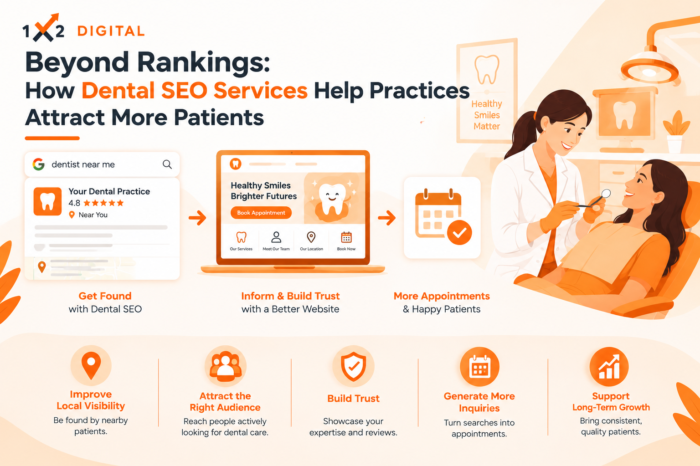
Beyond Rankings: How Dental SEO Services Help Practices Attract More Patients
- September 24, 2026
Introduction
A dental practice can have excellent doctors, advanced equipment, and years of experience. But when a patient searches online for a dentist or a specific treatment, those strengths only matter if the practice can be found.
That is where Dental SEO Services become valuable.
But good dental SEO is not simply about moving a website from page two to page one. A ranking has little business value if it attracts the wrong audience, sends visitors to an unhelpful page, or leaves potential patients unsure about what to do next.
The real opportunity is much bigger: helping the right patients discover the practice, find the information they need, trust the business, and take the next step.
The Search Result Is Only the Beginning
Imagine someone searches for a dentist after dealing with persistent tooth pain.
They may first look for a nearby clinic. Then they may check which practices offer the treatment they need, read reviews, visit a few websites, compare their options, and eventually decide where to make an appointment.
SEO influences several of these moments.
This is why a successful dental SEO strategy should not treat search rankings as the final destination. The ranking is the entry point. What happens after the click is equally important.
A useful way to look at the patient journey is:
Search → Discover → Understand → Trust → Contact → Appointment
If one of these stages is weak, the value of the SEO investment can also be weakened.
Start With What Patients Are Actually Looking For
One of the biggest mistakes in SEO is starting with keywords instead of people.
A dental practice may want to rank for broad terms related to dentistry, but patients rarely search with the same priorities as a business owner.
Someone might search for a dentist nearby. Another person may be researching a particular procedure. Someone else may have a specific concern and be trying to understand whether professional treatment is necessary.
These searches carry different levels of intent.
A mature Dental SEO strategy separates those intents instead of treating every keyword equally.
For example:
- Informational searches can lead to educational resources.
- Treatment-related searches can lead to detailed service pages.
- Location-based searches can lead to local landing pages or the practice profile.
- High-intent searches can lead directly toward contact or appointment options.
The objective is not to attract the maximum possible traffic.
It is to attract relevant traffic that has a reason to consider the practice.
Make the Practice Visible Where Local Patients Are Searching
For most dental practices, location is not a minor SEO factor. It is part of the buying decision.
A patient looking for dental care usually wants a practice that is accessible, convenient, and appropriate for their needs. That makes Local SEO for Dentists an important part of the overall strategy.
Local visibility can involve several connected areas:
- A properly maintained Google Business Profile
- Accurate name, address, phone, and business information
- Consistent local listings
- Genuine patient reviews
- Location-relevant website content
- Clear information about the areas the practice serves
- Strong internal links between location and treatment pages
However, local SEO should never become a game of repeating a city name throughout a website.
A useful local page should actually help someone decide whether the practice is convenient for them.
Where is the clinic? What treatments are available? How can the patient contact the practice? What should they expect when they visit?
Those answers are useful to both the searcher and the business.
The Website Has to Earn the Click
Getting a patient from Google to the website is an achievement. Keeping their attention is the next challenge.
A potential patient should not have to search through several pages to understand what a practice offers.
If someone searches for a particular treatment, the landing page should explain that treatment clearly. If they are looking for a local dentist, the website should make the practice’s location and contact information obvious.
Good dental websites usually make the important things easy to find:
- Treatments and services
- Dentist and practitioner information
- Clinic location
- Contact details
- Appointment options
- Frequently asked questions
- Helpful treatment information
- Clear next steps
The mobile experience matters just as much. A patient searching from a phone should be able to read the page, find the information they need, and contact the practice without unnecessary friction.
This is one reason SEO and website experience should not be treated as separate activities.
SEO creates the opportunity. The website decides what happens with it.
Build Content That Helps Patients Make Decisions
Dental content should not exist simply because a keyword has search volume.
A good piece of content answers a question that a real patient may have.
Before booking treatment, patients may want to understand what a procedure involves, what questions they should ask, whether a treatment may be appropriate for them, or what the next step looks like.
These are opportunities for useful content.
Instead of publishing a large number of repetitive articles, a practice can build deeper resources around its important treatments and patient concerns.
For example, content around a particular procedure can answer common questions, explain the process in simple language, address preparation and aftercare, and then guide the reader toward the relevant service page.
This creates a more useful website and gives SEO Services for Dentists a clear purpose beyond keyword placement.
The best content does not feel like SEO content.
It feels like someone knowledgeable is answering the question properly.
Trust Can Be the Difference Between a Visit and an Inquiry
Patients are not choosing a dental practice based on search position alone.
Once they find a practice, they may look at reviews, practitioner profiles, treatment information, photographs, location details, and the overall quality of the website.
In other words, the search result creates awareness, but the digital experience helps shape confidence.
A practice can strengthen that experience by providing:
- Genuine reviews and patient feedback
- Clear practitioner information
- Accurate treatment descriptions
- Helpful educational content
- Professional and consistent branding
- Easy-to-find contact information
- Straightforward appointment guidance
The goal is not to make the website sound promotional at every opportunity.
It is to answer enough of the patient’s questions that contacting the practice feels like a natural next step.
Technical SEO Is the Foundation Patients Never See
Patients may never notice technical SEO when it is done correctly.
They simply experience a website that loads properly, works on their phone, has logical navigation, and takes them to the information they expect.
Behind that experience are technical elements such as:
- Page speed
- Mobile responsiveness
- Crawlability and indexation
- Internal linking
- URL structure
- Page hierarchy
- Broken-link management
- Metadata
- Structured data where relevant
As a dental website grows, structure becomes even more important.
A practice may have separate pages for multiple treatments, locations, dentists, and educational resources. Without a clear architecture, important pages can become difficult for both users and search engines to discover.
Technical SEO gives the rest of the strategy a stronger foundation.
Authority Is Built, Not Manufactured
Organic visibility becomes more sustainable when a dental website demonstrates genuine expertise and earns credibility over time.
That can come from useful content, strong website structure, relevant digital mentions, reputable links, and consistent information across the web.
A Dentist SEO Company may use content outreach, digital PR, and ethical link-building as part of this process.
But the objective should never be “more backlinks at any cost.”
A relevant mention from a trustworthy website can be far more meaningful than dozens of unrelated links.
The same principle applies to content.
Publishing more pages does not automatically create more authority. Publishing information that genuinely deserves to be referenced is a stronger long-term approach.
Dental SEO Is Moving Beyond Traditional Search
Search behavior continues to change.
People increasingly use conversational queries and expect search engines to understand complete questions rather than just individual keywords. Search experiences are also becoming more capable of summarizing information directly.
For dental practices, this makes clear and well-organized information increasingly important.
Instead of writing only for a keyword such as “dental clinic,” content can answer the actual questions behind that search.
What does the treatment involve?
Who may need it?
What should a patient know before contacting a clinic?
What questions should they ask?
What happens next?
Answering these questions clearly can make the website more useful across different search experiences.
Traditional SEO still matters. But the strongest foundation is content that is genuinely helpful to the person searching.
Measure the Business Impact, Not Just the Ranking
A ranking report can show where a website appears in search results.
It cannot, by itself, tell a practice whether SEO is helping generate business.
That is why performance should also be evaluated through meaningful actions such as:
- Relevant organic traffic
- Local search visibility
- Treatment-page engagement
- Phone calls
- Contact form submissions
- Appointment requests
- New patient inquiries
- Conversion rates
Consider two pages.
One receives thousands of visits but generates almost no inquiries.
Another receives fewer visitors but consistently brings people who contact the practice about a specific treatment.
For a dental business, the second page may be contributing more directly to growth.
This is why a strong Dental SEO Agency should connect SEO reporting with actual business objectives instead of treating rankings as the whole story.
What a Strong Dental SEO Strategy Looks Like
There is no single SEO activity that creates sustainable growth.
The strongest results usually come from several parts working together:
Understand patient intent
→ Identify valuable search opportunities
→ Build useful treatment and educational content
→ Strengthen local visibility
→ Improve technical performance
→ Create a trustworthy website experience
→ Make inquiries easy
→ Measure what happens after the click
This approach changes the question from:
“How do we rank for this keyword?”
to:
“What does a patient need at this moment, and how can the practice become the most useful next step?”
That is a much stronger foundation for long-term organic growth.
Choosing the Right Dental SEO Agency
Not every SEO agency approaches dental marketing in the same way.
Before choosing a partner, a practice should understand how the agency plans to approach search intent, local visibility, content, technical SEO, website experience, authority building, and measurement.
It is also worth asking how success will be reported.
A useful SEO report should explain more than whether rankings moved. It should show what was improved, what changed in search visibility, which pages are attracting relevant users, and whether those users are taking meaningful actions.
The right strategy should be built around the individual practice—not simply a standard list of SEO tasks repeated every month.
How 1into2 Digital Can Help Dental Practices
For a dental practice, SEO works best when search strategy, content, website experience, and digital marketing are connected.
At 1into2 Digital, the focus is on building digital strategies around business goals and audience behavior. For dental practices, that can mean identifying relevant search opportunities, strengthening organic and local visibility, improving the website experience, and creating clearer paths from search discovery to patient inquiry.
A practice may already have a good website and strong services. The opportunity is to make those strengths easier for the right audience to discover and understand.
That is where a focused digital strategy can add value.
Final Thoughts
The purpose of dental SEO is not to win a ranking position and stop there.
A successful search strategy should help a practice become visible when the right patient is looking, answer the questions that influence their decision, establish confidence, and make contacting the practice simple.
The real measure of SEO is not how impressive the ranking looks. It is how effectively that visibility helps the right patients move closer to care.
When search intent, local visibility, useful content, website experience, trust, and conversion work together, SEO becomes more than a marketing activity.
It becomes part of the patient acquisition journey.
FAQs
1. What are Dental SEO Services?
Dental SEO Services are search optimization strategies designed specifically for dental practices. They can include keyword research, technical SEO, content optimization, local SEO, website improvements, authority building, and performance measurement.
2. How can Dental SEO help a dental practice attract more patients?
Dental SEO can improve a practice’s visibility for relevant searches and help potential patients find useful treatment and practice information. When the website also provides a clear path to contact or book, organic visibility can create more opportunities for patient inquiries.
3. What is Local SEO for Dentists?
Local SEO for Dentists focuses on improving visibility when people search for dental services in a specific location. It can include Google Business Profile optimization, local website signals, accurate business information, reviews, and relevant location-based content.
4. How long does dental SEO take to produce results?
There is no fixed timeframe. Results can depend on the website’s existing condition, competition, location, content quality, authority, and the scope of the SEO strategy. Sustainable SEO generally requires consistent work rather than a short-term campaign.
5. Does a dental practice need a Dental SEO Agency?
A practice can manage some SEO activities internally, but an experienced Dental SEO Agency can provide specialist knowledge across technical SEO, content, local search, website optimization, and performance measurement. The right choice depends on the practice’s goals, resources, and existing capabilities.
More from our blog
See all posts